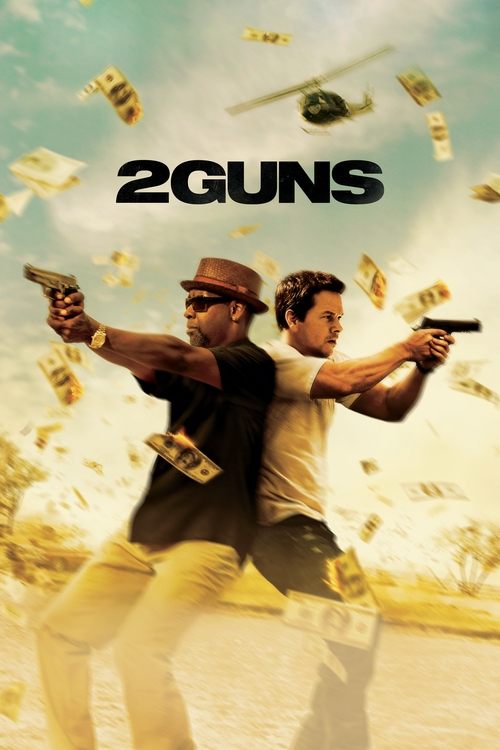
Woke rating
2 Guns
None or negligible
A buddy action-comedy whose crooked-officials plot is genre villainy rather than a message; its only political notes are a brief gag about border vigilantes and a cartel boss's jab at America.
Baltasar Kormákur's action-comedy stars Denzel Washington and Mark Wahlberg as Bobby and Stig, two small-time crooks who plan to rob a sleepy small-town bank near the border where they believe a Mexican cartel boss, Papi Greco, stashes his cash. Each is secretly an undercover lawman, Bobby with the DEA and Stig with Navy intelligence, and neither knows about the other. The robbery nets far more money than expected, and both men end up hunted by their own sides, the cartel and the money's real owners. Most of the film is banter, double-crosses, shoot-outs and car chases.
The plot runs on corrupt officials: the money's owners, Stig's superiors and someone close to Bobby all turn out to be crooked, and the film is cynical about the agencies involved. The closest it comes to a political point is a single line from Papi accusing America of keeping Mexico weak and corrupt. Separately, one short comic scene mocks two armed border vigilantes who demand Bobby's papers and want to make sure he is not a Muslim.
The plot runs on corrupt officials: the money belongs to the CIA, which takes a cut from every cartel in return for flying their drugs across the border; Stig's commander plots with Bobby's DEA lover Deb to steal it; and an admiral disowns Stig to keep the Navy's name clean. The closest the film comes to a political point is Papi telling the CIA man Earl that America likes Mexico weak and corrupt, and Earl replying that it is a free market, not a free world. Separately, one short comic scene mocks two armed border vigilantes who demand Bobby's papers and want to make sure he is not a Muslim.
What keeps the score at the bottom is that none of this is argued. There are no speeches about a cause, the villains come from every background and are driven by money, and the heroes are a federal agent and a sailor whose loyalty to each other is the film's real subject. The ethnic ribbing between the two leads is buddy-movie banter, not a point.
Score breakdown
Each category is scored 0 to 3: 0 absent or presence only, 1 brief, 2 recurring or plot-relevant, 3 central or dominant. Timestamps refer to the film's running time.
| Category | Score | What we saw |
|---|---|---|
| Content | ||
| A Ethnicity | 1 | One brief scene mocks self-appointed border vigilantes who profile Bobby, which counts as a passing point about ethnic profiling, and Papi makes one remark about how his people are forced to cross the border. Bobby, the Black lead, is a likeable but flawed undercover agent who robs a bank and trades insults with his partner, not a flawless figure, and the leads' ethnic banter is ribbing, not a message. Bobby and Deb are both Black Americans, so they are not a mixed couple.
|
| B Gender and feminism | 0 | Deb is a DEA agent and Bobby's on-off lover who betrays him, and Stig winks at every waitress. Nothing is framed as a point about gender. |
| C Sexuality and gender identity | 0 | No LGBTQ content; the Spanish slurs traded with Papi's men are insults, not a theme. |
| D Power and systems | 0 | Corrupt officials drive the plot: a CIA slush fund fed by the cartels (0:59:37), a crooked Navy commander and an admiral who covers it up (1:19:04), but as genre villainy driven by greed rather than oppression of a group. Papi's jab at America's treatment of Mexico is counted under J. |
| E Cultural and historical revision | 0 | No established characters, history or source material are recast to carry a message. |
| F Religion portrayal | 0 | Islam is not portrayed; the only mention is the vigilantes' line about Muslims. |
| K Diverse cast | 0 | The leads are a Black man and a white man, the buddy-movie pairing, and the Mexican and border characters are what the setting needs. Beyond Bobby the main cast is white; Deb, the one other Black character with a real part, is a plotterturns out to be one of the villains, so the mix comes down to a single minority lead. |
| Treatment | ||
| G Antagonist coding | 0 | The two vigilantes are bigoted white men shown up by the Black lead, but that is one short gag. Across the film the moral sides do not line up with ethnicity or sex: the villains are a Mexican cartel boss and several American officials, one of them a woman close to Bobbya Mexican cartel boss, a white CIA man, a white Navy commander and admiral, and Bobby's DEA lover Deb, a Black woman, all driven by money or self-protection, and the heroes are a Black man and a white man as equal partners. |
| H Didacticism | 0 | No speeches state a progressive message. The few set speeches, Earl's cynical creed and a talk about loyaltyBobby's 'there is no code' and the admiral's gangrene metaphor, are about greed and the bond between partners. |
| I Message over story | 0 | The story leads throughout; nothing bends to serve a message or the cast mix. |
| J Left-leaning politics framed as good | 1 | The only political lines come from villains: Earl's creed that America is great because it accepts man's greed, and a cartel boss's jab at AmericaPapi's charge that America keeps Mexico weak and corrupt for cheap goods, which Earl shrugs off as the free market. Scored 1: a couple of lines, never argued, and the film's distrust of government agencies is otherwise not framed in left or right terms.
|
How the number is reached
- Categories A to K add up to 2 of 33, which gives 0.5 (2 ÷ 33 × 10, rounded to the nearest 0.5).
- Counterweight −0.5: The antagonists have real individual motives and come from every background, from a Mexican cartel boss who has a man killed for skimming (0:09:51) to American officials after the money, while the lawman heroes are shown as capable and loyal.The antagonists have real individual motives and come from every background: a Mexican cartel boss who has a man killed for skimming (0:09:51), a CIA man protecting a cash stream, a Navy commander and Bobby's DEA lover Deb who want the money for themselves (1:21:37, 1:25:16), and an admiral protecting the Navy's name. The lawman heroes are shown as capable and loyal.
- Final rating 0.0, none or negligible.
Considered, scored 0
- Bobby's affair with fellow agent Deb (0:15:18; 0:15:30, 0:16:30): both are Black Americans, so not a mixed couple (A).
- Buddy-movie ethnic ribbing between the leads and Papi: 'Ebony and Ivory' (0:57:53), 'a Mexican Albert Einstein' (1:01:51) and 'a Mexican wedding' (1:33:28), plus Spanish insults traded at the ranch (0:10:03).
- A female border interrogator questions Stig (0:12:04; 0:12:30); he flirts with her, and his winking at waitresses is a running gag (0:03:32, 1:40:26).
- A Black woman at a store counter smiles at Stig (1:15:10; 1:15:30); a passing moment, no couple.
- The Black-and-white pairing of the two leads and the Mexican and border characters the setting needs (K).
Evidence and confidence
Confidence: Medium. A transcript of the English audio (the file has no English text subtitles). A few short Spanish exchanges are not transcribed (0:07:07, 0:09:20, 1:05:11 to 1:05:28, 1:10:12 to 1:10:20), and the transcript garbles some names (Stig as 'Stick', Tres Cruces as 'Trace Cruises'); the surrounding English dialogue and the picture make the action clear.
Category F definition: As in the rubric: Islam shown as a peaceful and tolerant religion, aligned with human rights, in a way that works as a corrective message.
Rubric version 3. Reviewed 18 November 2026.