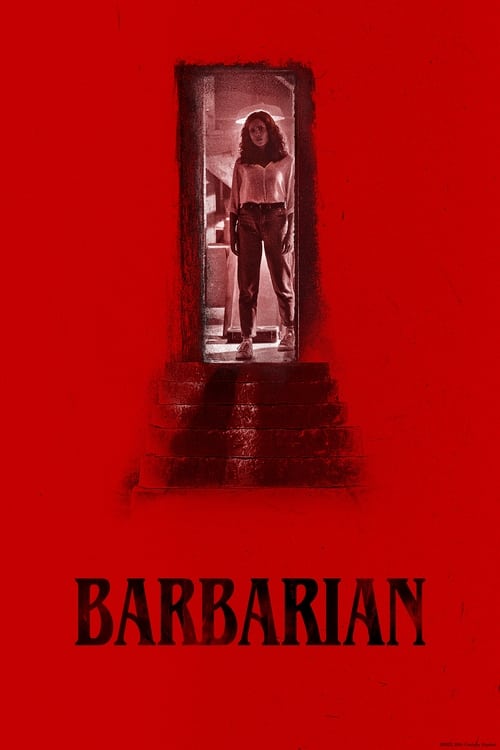
Woke rating
Barbarian
Mild
A twisty horror film about a double-booked rental whose running theme is the danger men pose to women, carried mostly by the story rather than speeches and complicated by the film's own misdirection.
Zach Cregger's horror film follows Tess Marshall (Georgina Campbell), who arrives late at night at a rental house on Barbary Street in a run-down part of Detroit, the night before a job interview, and finds it double-booked by a stranger, Keith (Bill Skarsgård). She stays, and the house turns out to hide more than a basement. Halfway through, the film cuts to a second story about AJ (Justin Long), a TV actor whose career collapses when a co-star accuses him of rape and who comes to Detroit to sell off property, and later to a third strand set in the 1980s.
Men as a threat to women runs through every section. The first act's suspense rests on whether Keith can be trusted, and over wine Tess spells out why women have to be careful around men and men do not. AJ denies the accusation in public and admits to a friend that the woman said no at first. The house's history, when it comes, is about male predation too, and when Tess needs help, the police and a 911 operator fail her.
Men as a threat to women runs through every section. The first act's suspense rests on whether Keith can be trusted, and over wine Tess spells out why women have to be careful around men and men do not. AJ denies the accusation in public and admits to a friend that the woman said no at first. The 1980s flashback shows Frank, the house's original owner, kidnapping women and keeping them in tunnels under the house, where he fathered children on them and on those children; the creature is the result. When Tess escapes, the police treat her as a drug user and drive off, and at the climax AJ throws her to the creature to save himself.
What keeps the score in the mild band is that the theme is shown through a horror story rather than argued: there is one conversation that states it, and no politics, identity speeches or causes. The film also plays against its own premise: the people Tess fears are not always the ones who threaten her, and the men in the film are not all of one kind.
What keeps the score in the mild band is that the theme is shown through a horror story rather than argued: there is one conversation that states it, and no politics, identity speeches or causes. The film also plays against its own premise: Keith, the stranger Tess suspects, is kind and dies going to look at what she found; the homeless man she runs from is the one who frees and shelters her; and the monster is a woman, herself the product of a man's crimes.
Score breakdown
Each category is scored 0 to 3: 0 absent or presence only, 1 brief, 2 recurring or plot-relevant, 3 central or dominant. Timestamps refer to the film's running time.
| Category | Score | What we saw |
|---|---|---|
| Content | ||
| A Ethnicity | 0 | Ethnicity is never mentioned. Tess, a woman of colour, is a sympathetic heroine but not a flawless one: she keeps going back to a controlling ex, and the people she fears are not always the ones who threaten hershe misjudges both Keith and the Black homeless man Andre, fearing the wrong people. Andre turns out to be on her sidefrees and shelters her but has a small part and is first shown as menacing. Tess and Keith, who is white, flirt over one evening but are not a couple, and no mixed couple appears. Detroit's decline is backdrop; see 'zeroed'. |
| B Gender and feminism | 3 | The danger men pose to women is the thread that ties the film's sections together: a woman alone with a strange man, a man accused of rape, and a house with a history of preying on women, a 1980s kidnapper who kept women captive, and a climax in which a man sacrifices a woman to save himself. Scored 3 as the dominant theme, although apart from one conversation it is carried by the story rather than argued, and the film complicates it (see counterweight).
|
| C Sexuality and gender identity | 0 | No LGBTQ content. A friend's slur in greeting AJ is banter (see 'zeroed'). |
| D Power and systems | 0 | A neglected neighbourhood gets no help: a 911 operator has no units to send (0:27:53), and later policewhen Tess finally reaches the police, they dismiss her and leave (1:22:23, 1:24:32). It is a horror device in one scene and a phone call, not an institution framed as oppressing a group; the officer is Black and the film draws no ethnic point. |
| E Cultural and historical revision | 0 | An original screenplay. No established characters or history are recast. |
| F Religion portrayal | 0 | Islam does not feature. |
| K Diverse cast | 0 | Tess is the one non-white lead; Keith, AJ, Frank, AJ's friends and his mother are white. Andre and the Black police officer belong to a run-down Detroit neighbourhood, the mix the real place makes likely, and no character's sexuality or religion is at issue, so the cast does not count as mixed. |
| Treatment | ||
| G Antagonist coding | 1 | The human villains are white men defined by how they treat women: an entitled actor and a predator from the house's pastand Frank, a kidnapper and rapist, while the heroine is a woman of colour and a Black homeless man turns out to be on her sideAndre, a Black homeless man, frees and shelters her. Scored 1 for those two characters, not more: the sides do not divide along sex or ethnicity, since Keith, a white man, is kind and dies going to look at what she found, the police who brush Tess off include a Black officer, and the main threat is not a manthe creature that drives the horror is a woman.
|
| H Didacticism | 1 | One conversation states the theme directly, in character and as part of the first act's suspense; the rest is left to the story.
|
| I Message over story | 0 | The story leads. The cut to AJ's storyline is a structural surprise, but each turn follows from the characters and the horror set-up, and AJ's last act is foreshadowed by his self-serving apology and his accident with the gun (0:55:41, 1:28:50). |
| J Left-leaning politics framed as good | 1 | No political camp is named, but the film sides plainly with the accuser in a #MeToo-style story: the man who calls the charge '100% not true' is shown to be lying, and his self-pity is mocked.
|
How the number is reached
- Categories A to K add up to 6 of 33, which gives 2.0 (6 ÷ 33 × 10, rounded to the nearest 0.5).
- Counterweight −0.5: the film plays against its own premise: the stranger Tess fears at first is not the danger, a man she runs from turns out to be on her side, and the monster is not a man.Keith, whom Tess suspects, is kind throughout and dies going to look at what she found (0:11:03, 0:35:30, 0:42:27); Andre, the homeless man she flees (0:27:17), frees her and later shelters her and AJ (1:17:34, 1:30:04); and the creature is a woman, herself the product of Frank's crimes (1:30:50).
- Final rating 1.5, mild.
Considered, scored 0
- Tess, a woman of colour, as the lead: sympathetic but not flawless, since she fears the wrong people (A). She and Keith, who is white (0:04:30, 0:10:30), share a friendly evening and say they liked it (0:19:43), but they are not a couple.
- Andre, the homeless man who shouts at Tess from the street (0:27:17), is Black and turns out to be warning her; the film makes nothing of his ethnicity, and his small part is first played for menace (A).
- Detroit's decline: Catherine warns Tess she should not stay in Brightmoor (0:25:32), and a period scene shows the neighbourhood emptyingand in the 1980s a neighbour tells Frank he is selling because the neighbourhood is going to hell (1:11:37), after a radio line about Reagan's inherited economy (1:06:47). Backdrop, with no comment on ethnicity or policy.
- AJ's friend greets him with a gay slur (0:54:11), locker-room banter.
- A Black police officer among those who dismiss Tess (1:24:30), and Andre: the people a run-down Detroit neighbourhood would really have (K).
Evidence and confidence
Confidence: Medium. Full English subtitles from the file's embedded track, covering the whole film including the song lyrics. The source is HDR and very dark, so many night and basement scenes show little (for example 0:20:30 to 0:22:30, 0:40:30 to 0:41:30, 1:19:30 to 1:21:30); the dialogue covers those stretches.
Category F definition: As in the rubric: Islam shown as a peaceful and tolerant religion, aligned with human rights, in a way that works as a corrective message.
Noted, not scored: One point cuts the other way: Keith's old-fashioned insistence, put down to his upbringing, that a young lady should not sleep on the couch (0:11:03) is left open for a whileturns out to be sincere courtesy rather than a ploy.
Rubric version 3. Reviewed 18 November 2026.