Woke rating
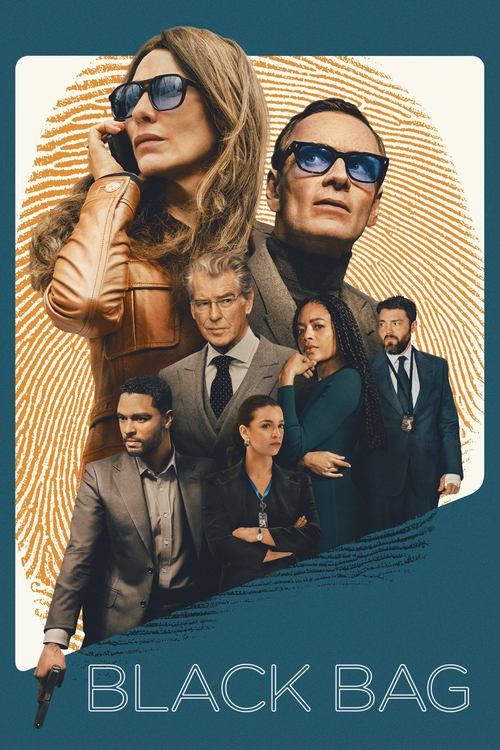
Black Bag
None or negligible
A tightly wound spy thriller about a marriage and a mole, with a mixed cast and plenty of frank talk about sex, but no progressive messaging to speak of.
Steven Soderbergh's thriller follows George Woodhouse, a British intelligence officer who hunts leaks. He is told that one of five colleagues has stolen a cyberweapon called Severus, and that one of the five is his wife, Kathryn. He invites the suspects to dinner, spikes the curry and watches. The rest is a tight puzzle of polygraphs, satellites and a marriage in which both partners keep secrets for a living.
The dinner-table banter touches on a cyberattack in Syria that killed civilians, Edward Snowden, affairs, drugs and one colleague's vicious tirade at his girlfriend. None of it is framed as a message: the Syria exchange ends in a joke about amorality, and the tirade marks its speaker as a boor. The cast is mixed, as a modern London service would be, and one brief affair between colleagues is a mixed couple, with no comment on ethnicity.
The dinner-table banter touches on a cyberattack in Syria that killed civilians, Edward Snowden, affairs, drugs and one colleague's vicious tirade at his girlfriend. None of it is framed as a message: the Syria exchange ends in a joke about amorality, and the tirade marks its speaker as a boor. The cast is mixed, as a modern London service would be, and Freddie's secret affair with the agency psychiatrist, Dr. Vaughan, is a mixed couple, with no comment on ethnicity. The mole turns out to be Stokes, working with the agency chief Stieglitz, who meant to melt down a Russian reactor to topple the regime; Dr. Vaughan's faith leads her to help stop it.
The score stays at the bottom of the scale because the film has no speeches, no ideological villains and no politics beyond the spy world's shared dislike of the Moscow regime. The villains have personal motivesThe villains act out of ambition and a belief that the meltdown would end a war, and the moral centre is a faithful marriage.
Score breakdown
Each category is scored 0 to 3: 0 absent or presence only, 1 brief, 2 recurring or plot-relevant, 3 central or dominant. Timestamps refer to the film's running time.
| Category | Score | What we saw |
|---|---|---|
| Content | ||
| A Ethnicity | 0 | One brief affair between colleagues is a mixed couple, revealed in dialogue rather than shownFreddie's affair with Dr. Vaughan, a white man and a Black woman, is revealed in dialogue rather than shown, and she began it to manipulate him. It is a background couple (1) of two British colleagues who differ only in skin colour (minus 1), so it scores 0. No minority character is portrayed as flawless: Stokes is the mole and Dr. Vaughan a manipulator, and ethnicity is never mentioned. |
| B Gender and feminism | 0 | Women hold senior and specialist posts, and Freddie's tirade at Clarissa is ugly, but neither is framed as a point about gender. Freddie's sexism is a flaw the film punishes, not a thesis. |
| C Sexuality and gender identity | 0 | No LGBTQ+ content. The characters talk frankly about sex, erotica and affairs, but as character and leverage, not as advocacy; the affairs make people easy to manipulate. |
| D Power and systems | 0 | The intelligence world is shown as amoral and the agency chief sneers at the CIA, but as spy-thriller cynicism, not as oppression of a group. One line asks how many civilians a Syrian operation killed, and the answer is a shrug. |
| E Cultural and historical revision | 0 | An original spy story. No established characters or history are recast; real-world references such as Stuxnet and Snowden are used as background. |
| F Religion portrayal | 0 | Islam does not feature. |
| K Diverse cast | 0 | Two of the five suspects are Black, Colonel Stokes and Dr. Vaughan, in a modern London intelligence service, which accounts for that much mix. Neither is held up as a modelStokes is the mole, so he does not add to the mix, which leaves Dr. Vaughan as the one minority character with a real part. Nobody is gay, and religion comes up only as Dr. Vaughan's Catholic schooling (0:33:50). |
| Treatment | ||
| G Antagonist coding | 0 | The culprits have personal motives, and the moral sides do not divide by ethnicity or sexThe culprits are a white man and a Black man, Stieglitz and Stokes, with personal motives: Stokes's ambition and belief that the plan would end the war, and Stieglitz's wish to topple Moscow and be rid of Kathryn, who threatened his job. The heroes are a white couple, and the Russian regime is a shared enemy, not a coded group. |
| H Didacticism | 0 | No speeches or lectures. The longest outbursts are Freddie's personal abuse of Clarissa and Clarissa's lament that spies cannot date anyone, neither of which carries a social message. |
| I Message over story | 0 | The plot is a mole hunt and a marriage puzzle, and none of its turns bends toward a message. |
| J Left-leaning politics framed as good | 0 | No politics are argued. Snowden comes up only as a sneer over dinner, and the plan to strike at Moscowmelt down a Russian reactor is judged by its death toll, not by left or right. |
How the number is reached
- Categories A to K add up to 0 of 33, which gives 0.0 (0 ÷ 33 × 10, rounded to the nearest 0.5).
- No counterweight: None applies: there is almost no progressive messaging to complicate or mock.
- Final rating 0.0, none or negligible.
Considered, scored 0
- The five suspects include two Black officers, Colonel Stokes and Dr. Vaughan, in a modern London service that would have some mix, shown without comment (K).
- A brief affair between colleaguesFreddie's affair with Dr. Vaughan (1:21:41), which she began as manipulation: a background couple of two British colleagues who differ only in skin colour (A).
- Dr. Vaughan's relationship with Stokes (0:32:18), both Black, shown without comment.
- Women in senior and specialist posts (Kathryn, the satellite specialist Clarissa, the agency psychiatrist), shown without comment; Clarissa's praise of Kathryn as one of the 'bad bitches' (0:11:20) is banter.
- Freddie's sexist tirade at Clarissa (0:18:10), a mark of his character that earns him her steak knife through his hand (0:43:32), not a point about men.
- Stieglitz telling Kathryn she 'cannot have it all' (0:33:27), told as office power play rather than a point about women.
- Frank talk about sex, erotica, drugs and affairs (0:15:01, 0:45:08), treated as character and leverage, not as sexual-freedom advocacy.
- Dinner banter about a Western cyberattack in Syria that killed civilians and about Snowden (0:10:53), and the chief's contempt for the CIA (0:58:43): spy-world cynicism, not a critique of the services as oppressors.
Evidence and confidence
Confidence: Medium. Full English subtitles (the embedded track). The picture is dark, as the film is, but readable. No stretch of dialogue was missing; a meeting overheard through a door (0:27:35) is only partly subtitled.
Category F definition: As in the rubric: Islam shown as a peaceful and tolerant religion, aligned with human rights, in a way that works as a corrective message.
Noted, not scored: The film's moral centre is a faithful marriage: George's 'flagrant monogamy' is teased (0:03:54), but the couple's loyalty wins out and rests on faith in each other (1:29:11), while the cheating colleagues are the ones who get manipulated. Religion appears once, in a good lightas the reason Dr. Vaughan, a Catholic, acts to stop a meltdown that would kill tens of thousands (1:23:41).
Rubric version 3. Reviewed 17 November 2026.