Woke rating
Buddy
None or negligible
A horror comedy that turns a sugary children's TV show into a nightmare, with a mixed young cast but no progressive messaging to speak of.
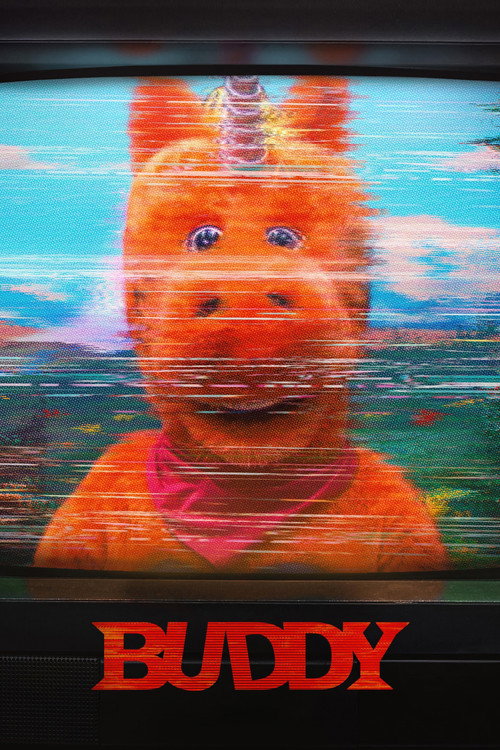
Buddy is a horror comedy built around a children's programme in the style of the 1990s. Buddy, an orange unicorn, sings lessons about bravery, cleaning and saying sorry to a group of kids in a pastel park, until Freddy and her friends notice that children who displease him vanish and that Buddy lies. A second strand follows Grace, a suburban mother who cannot shake the feeling that something is missing from her family.
There is very little to count. The show's cast of children and hosts is ethnically mixed, without comment. In the real world, Grace's husband dismisses her fears and the psychic she hires. On the road, the children meet two exiles, an old man and a puppet, who declare their love in a short comic scene. A few lines about therapy and self-care are played as awkward comedy between the parents.
There is very little to count. The show's cast of children and hosts is ethnically mixed, without comment. In the real world, Grace's husband dismisses her fears and the psychic she hires, but she is right: Freddy is the third child the family has forgotten, and Grace is pulled into the show to save her. On the road, the children meet two exiles, an old man and a puppet, who declare their love in a short comic scene before Buddy finds them. A few lines about therapy and self-care are played as awkward comedy between the parents.
Nothing here is argued. The film's target is the sugary moralising of children's television and love demanded on pain of punishment, and its villain is a puppet with no demographic or political coding. The mother doubted by a sceptical husband is a staple of the genre and is not framed as a point about men and women.
Score breakdown
Each category is scored 0 to 3: 0 absent or presence only, 1 brief, 2 recurring or plot-relevant, 3 central or dominant. Timestamps refer to the film's running time.
| Category | Score | What we saw |
|---|---|---|
| Content | ||
| A Ethnicity | 0 | The show has an ethnically mixed cast (Wade, Hannah, Mailman Miles, Nurse Nancy), shown without comment, and none of them is held up as flawless: they are children and hosts in a parody. The one real-world couple, Grace and Ben, is not mixed. |
| B Gender and feminism | 0 | Grace's husband doubts her and Freddy, a girl, learns to be bravelearns to be brave and leads the escape, but neither is framed as a point about gender. |
| C Sexuality and gender identity | 0 | Two exiles, an old man and a puppet, profess their love in one comic scene (0:59:38). It is a gag with no commentary, so it scores 0 as presence only. |
| D Power and systems | 0 | No real-world institution is criticised. The satire of a moralising children's show and a host who demands love is not framed as oppression of a group. |
| E Cultural and historical revision | 0 | An original story. No established characters or history are recast. |
| F Religion portrayal | 0 | Islam does not feature, and religion plays no part in the story. |
| K Diverse cast | 0 | The children and hosts on the show are mixed across ethnicity: Wade and Mailman Miles are Black, Hannah and Nurse Nancy East Asian, Freddy and Oliver white (0:01:30, 0:08:30, 0:18:30). That is the mix American educational children's programmes of the 1990s, which the film parodies, deliberately put on screen, so the setting accounts for it. The real-world family is white, and no character's sexuality or religion is part of the mix. |
| Treatment | ||
| G Antagonist coding | 0 | The villain is Buddy, a unicorn puppet driven by a need to be loved; he has no ethnic, sex or ideological coding, and the adults who doubt Grace are not set against a minority or female good side. |
| H Didacticism | 0 | The only lectures are the show's parody lessons on bravery, cleaning, safety and apologising (0:12:30, 1:09:13), none of which carries a political or identity message. |
| I Message over story | 0 | The plot follows the children's escape and the mother's search; nothing bends toward a message. |
| J Left-leaning politics framed as good | 0 | No politics appear anywhere in the film. |
How the number is reached
- Categories A to K add up to 0 of 33, which gives 0.0 (0 ÷ 33 × 10, rounded to the nearest 0.5).
- No counterweight: None applies: there is no progressive messaging to complicate or mock.
- Final rating 0.0, none or negligible.
Considered, scored 0
- An ethnically mixed cast of children and hosts on the show (Wade, Hannah, Mailman Miles, Nurse Nancy), shown without comment, the mix of the 1990s children's programmes the film parodies (A, K).
- Grace's husband Ben dismissing her fears and her psychic (0:41:39, 0:42:49), though she turns out to be right: a genre staple, not framed as a point about gender.
- Freddy, a girl, overcoming her fear and leading the escape (1:03:12); bravery is the show's lesson for every child, not a point about girls.
- The exiles Willie and George, a puppet and an old man, declaring their love in one comic scene (0:59:38), with no commentary.
- Grace's visit to a therapist and her husband's awkward assurance that self-care is nothing to be embarrassed about (0:33:50).
Evidence and confidence
Confidence: Medium. Full English subtitles from the embedded track, songs included. The last few minutes are credits.
Category F definition: As in the rubric: Islam shown as a peaceful and tolerant religion, aligned with human rights, in a way that works as a corrective message.
Rubric version 3. Reviewed 17 November 2026.