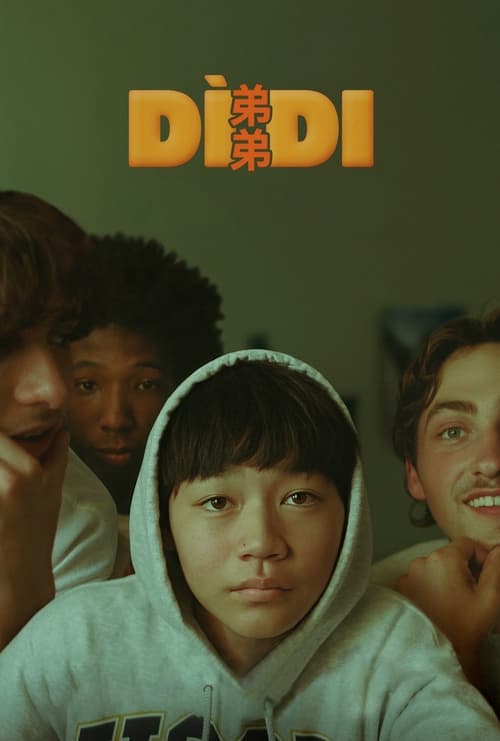
Woke rating
Dìdi (弟弟)
None or negligible
A coming-of-age comedy-drama about a Taiwanese-American boy in 2008 Fremont with almost no messaging: its few points come from a teenage crush across ethnic lines and a boy's embarrassment about his Asian family, shown rather than preached.
Sean Wang's film follows Chris, a 13-year-old Taiwanese-American boy in Fremont, California, through the last summer before high school in 2008. He lives with his mother, an amateur painter, his older sister Vivian, who is about to leave for college, and his grandmother, while his father works in Taiwan. The film is built from MySpace, AIM and YouTube screens, skate videos, a first crush and loud family fights.
Its scored points come from ethnicity, and they are shown rather than argued. Chris's crush on Madi, who is not Asian, is the film's only romance, a mixed pairing whose difference the film makes part of the story. Around it, Chris's unease about being Asian keeps surfacing: Madi tells him he is cute for an Asian, he tells his mother she is 'so Asian', and he tells a crowd of older skaters that he is half-Asian, a lie that comes back to bite him, a lie his mother unknowingly exposes in front of them. A thread about his mother's lost ambitions as an artist and her mother-in-law's scorn adds a point under gender.
What keeps the score this low is that none of it is preached. The ethnicity moments play as awkward teenage comedy and insecurity, with no lecture about racism, and the mother's story is told as one woman's regrets that end in love for her childrenthat end with her telling Chris that her children are her dream. The boys' casual homophobic jokes are period talk, and nothing in the film carries a political point.
Score breakdown
Each category is scored 0 to 3: 0 absent or presence only, 1 brief, 2 recurring or plot-relevant, 3 central or dominant. Timestamps refer to the film's running time.
| Category | Score | What we saw |
|---|---|---|
| Content | ||
| A Ethnicity | 1 | Chris's crush on Madi, who is not Asian, is the film's only romance: one date and its aftermath, a supporting thread beside Chris and his mother (2). The two differ in background more than in skin colour, and the story makes that difference part of the plot and deals with it, through her 'cute for an Asian' line and his embarrassment about his family, so 1 comes off (1). Chris's unease about being Asian recurs around it and drives one plot turn, but it is shown as adolescent insecurity, not argued as a point about racism, and no character is held up as flawless.
|
| B Gender and feminism | 1 | The mother's lost career as an artist and her mother-in-law's contempt are a thread and the subject of the closing heart-to-heart. Scored 1: it is told as one woman's story and resolves in her love for her children, not in a point about men or marriage.
|
| C Sexuality and gender identity | 0 | No LGBTQ theme. The boys' homophobic jokes and one slur are period teen talk with no comment (see zeroed). |
| D Power and systems | 0 | No critique of institutions. A security guard chasing the skaters off a car park is skate-film mischief. |
| E Cultural and historical revision | 0 | An original story. No established characters or history are recast. |
| F Religion portrayal | 0 | Islam never comes up. |
| K Diverse cast | 0 | The cast is largely Asian-American, with Taiwanese, Korean, Pakistani and Indian-American friends and a few white and Black skaters. That is what Fremont, a mostly Asian Bay Area suburb, really looked like in 2008, so the mix is the setting's. No main character is gay, and religion does not come up. |
| Treatment | ||
| G Antagonist coding | 0 | There are no villains in the usual sense. The friction is with family, friends who drift away, older skaters of every background who rib Chris, and a classmate who taunts him and gets punched, all defined by their behaviour rather than by ethnicity or sex. |
| H Didacticism | 0 | No speeches state a message. The mother's late heart-to-heart is about family, not politics. |
| I Message over story | 0 | The story leads throughout; no scene bends to make a point or to serve the cast. |
| J Left-leaning politics framed as good | 0 | No political content of any kind. |
How the number is reached
- Categories A to K add up to 2 of 33, which gives 0.5 (2 ÷ 33 × 10, rounded to the nearest 0.5).
- No counterweight: None applies: the film argues no progressive point, so there is nothing for it to mock or balance. The crush is shown, not argued, and the ethnicity moments are a boy's embarrassment rather than a message.
- Final rating 0.5, none or negligible.
Considered, scored 0
- A largely Asian-American cast and Chris's Taiwanese, Korean, Pakistani and Indian-American friends, shown without comment and true to Fremont (K); one boy calls Fahad the future first brown EGOT winner (0:11:05).
- The boys' jokes that camo shorts are gay (0:09:09) and a slur used to taunt Chris late onthe slur Josh uses to taunt Chris before Chris punches him (1:15:17), period teen talk with no point made about it.
- The grandmother's traditional expectations: boys must eat to become strong men (0:03:03), and a fight could end the Wang family line (0:21:01), played as family comedy.
- Vivian telling her mother not to comment on her body (0:25:38), a teenage aside.
- Slurs and ethnic ribbing among the older skaters at a party (1:00:45, 1:01:04), period colour.
- A security guard chasing the skaters off a car park (0:54:19), skate-film mischief.
- A girl's remark that Chris's dead-squirrel story is animal cruelty and that a girl's mother works for PETA (0:44:20), a joke at his expense.
Evidence and confidence
Confidence: Medium. Full English subtitles (the embedded track, which also translates the Mandarin dialogue) plus the forced track. Two stretches have no dialogue (1:11:53 to 1:14:20, 1:17:13 to 1:20:32).
Category F definition: As in the rubric: Islam shown as a peaceful and tolerant religion, aligned with human rights, in a way that works as a corrective message.
Rubric version 3. Reviewed 18 November 2026.