Woke rating
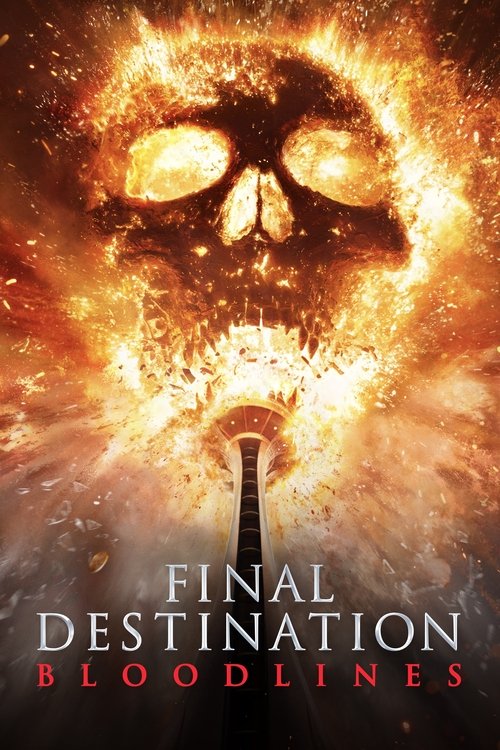
Final Destination Bloodlines
None or negligible
A gory franchise sequel about a family hunted by Death, with no progressive messaging: its subject is fate, family and inherited fear.
The sixth Final Destination film opens about fifty years in the past at the Sky View, a new tower-top restaurant, where a young woman named Iris (Brec Bassinger) foresees a collapse that kills everyone. In the present her granddaughter Stefani (Kaitlyn Santa Juana), a college student failing her classes, has the same dream every night and goes home to find the grandmother her family has cut off. The hermit Iris tells her that Death is coming for every descendant of the people she saved, because they were never meant to be born.
There is almost nothing here for the rubric to find. Stefani's family is mixed: her father Marty is Asian, and her mother Darlene, who walked out when Stefani was ten, is white. The 1960s restaurant crowd includes Black guests, staff and a singer. None of it is remarked on. The family drama is about estrangement and inherited fear: a grandmother whose paranoia got her children taken into care, and a mother who left so as not to pass that fear on. The cousins mock Stefani's warnings until the accidents start.
There is almost nothing here for the rubric to find. Stefani's family is mixed: her father Marty is Asian, and her mother Darlene, who walked out when Stefani was ten, is white. The 1960s restaurant crowd includes Black guests, staff and a singer. None of it is remarked on. The family drama is about estrangement and inherited fear: a grandmother whose paranoia got her children taken into care, and a mother who left so as not to pass that fear on, then gives her life to shield her children. Iris, Howard, Julia and Erik die one by one in elaborate accidents, an affair is revealed to explain why Death's order went wrong, and Stefani and Charlie think they have escaped until the last scene.
The score is zero because nothing is argued. The only antagonist is Death itself, and the plot runs on chains of accidents, not on any social theme. The jokes about a restaurant finished months ahead of schedule and a maître d' who favours a VIP are set-up for the disaster. Stefani's parents are a mixed couple, but they are two Americans who differ only in looks and appear together only as an estranged pair, and a family like theirs is ordinary in present-day America.
Score breakdown
Each category is scored 0 to 3: 0 absent or presence only, 1 brief, 2 recurring or plot-relevant, 3 central or dominant. Timestamps refer to the film's running time.
| Category | Score | What we saw |
|---|---|---|
| Content | ||
| A Ethnicity | 0 | Ethnicity never comes up, and no non-white character is held up as flawless. Stefani's parents, an Asian father and a white mother, are a mixed couple, scored in steps: 1 for prominence, since they are long separated and share only a few tense scenes (0:41:30, 1:08:53), minus 1 because both are Americans of the same culture who differ only in skin colour, which leaves 0. The mixed 1960s crowd is presence only. |
| B Gender and feminism | 0 | The leads are women (Iris, Stefani, Darlene), but nothing is framed through gender. Stefani's bitter remark that not everyone wants to be a mom (1:12:34) is a daughter's grievance, and Darlene answers it with her own story of inherited fear (1:12:47). |
| C Sexuality and gender identity | 0 | No LGBTQ characters or themes. Charlie's prom date is a girl he met at junior lifeguards (0:25:28). |
| D Power and systems | 0 | The Sky View is boasted to have been finished five months ahead of schedule (0:03:56), and the maître d' turns Paul away while seating a VIP (0:05:35). Both are set-up for the disaster, not a critique of business or class. The State taking Iris's children into foster care (0:27:50) is told as necessary protection. |
| E Cultural and historical revision | 0 | An original story within the franchise, with new characters. Bludworth returns with the same actor, and earlier films are referenced (1:16:53); nothing is recast. |
| F Religion portrayal | 0 | Religion appears only as a Bible reading at a funeralHoward's funeral (0:50:58). Islam is not portrayed. |
| K Diverse cast | 0 | The characters with a real part are Stefani's white extended family, her Asian father and the two half-Asian children, plus Bludworth, a returning franchise character played by the same Black actor, in one scene. A family with an Asian father is ordinary in present-day America, the Black singer and doorman of the 1960s prologue are small parts or extras, and no character's sexuality or religion is marked, so nothing adds to a mixed cast. |
| Treatment | ||
| G Antagonist coding | 0 | The antagonist is Death itself (0:36:47), and no character is cast as the bad side by ethnicity or sex. Family members who doubt Stefani are shown as frightened or grieving, not as villains. |
| H Didacticism | 0 | No speeches carry a social message. Howard's toast about loving the family you have (0:45:19) and Bludworth's advice to treasure the time left (1:18:14) are about mortality, which falls outside the rubric. |
| I Message over story | 0 | The story serves the franchise's death traps and the family drama; none of its turns bend toward a message. |
| J Left-leaning politics framed as good | 0 | No political positions appear, left or right. |
How the number is reached
- Categories A to K add up to 0 of 33, which gives 0.0 (0 ÷ 33 × 10, rounded to the nearest 0.5).
- No counterweight: None applies: there is no messaging to complicate or mock.
- Final rating 0.0, none or negligible.
Considered, scored 0
- Marty and Darlene, Stefani's Asian father and white mother (0:41:30, 1:08:53), an estranged couple who share an American upbringing and differ only in skin colour (A).
- Stefani and Charlie as mixed-ethnicity siblings (1:01:30, 1:10:30), shown without comment, in a family the present-day setting makes ordinary (K).
- The 1960s Sky View crowd, with a Black doorman, Black guests and a Black singer who talks to Iris in the ladies' room (0:02:30, 0:07:57), shown without comment; extras and a small part (K).
- Bludworth, the franchise's returning mortician, played by the same actor as before (1:18:30), in one scene (K).
- The restaurant built ahead of schedule (0:03:56) and the maître d' favouring a VIP (0:05:35), set-up for the disaster rather than social criticism.
- Stefani's jab that not everyone wants to be a mom (1:12:34), a family grievance rather than a statement about motherhood.
- A family secret about Erik's fatherBrenda's admission that Erik is not Howard's son (1:06:50), a plot device that explains Death's order.
Evidence and confidence
Confidence: Medium. Full English subtitles from the embedded dialogue track. Several of the death set pieces play with little or no dialogue.
Category F definition: As in the rubric: Islam shown as a peaceful and tolerant religion, aligned with human rights, in a way that works as a corrective message.
Rubric version 3. Reviewed 17 November 2026.