Woke rating
Jackpot!
None or negligible
A broad action comedy about a lottery whose winner anyone may legally kill before sundown, with a light satire of greed, a couple of gender jokes and a recurring mixed couple; its few lines of identity talk are played for laughs at the speaker's expense.
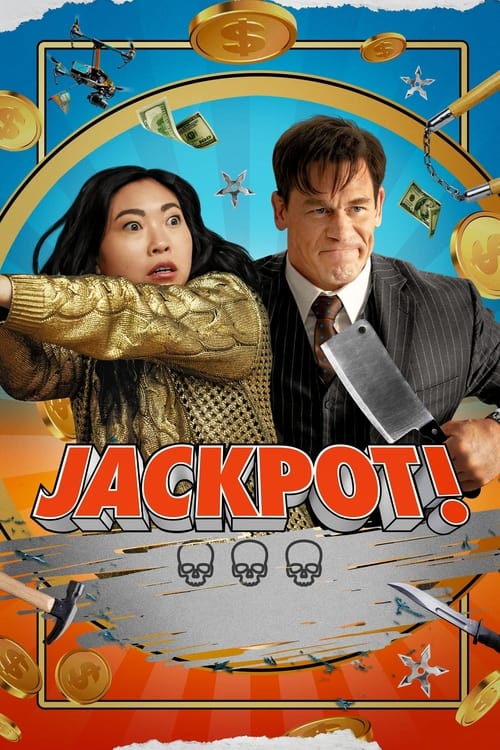
Paul Feig's action comedy is set in a near-future Los Angeles where the 'Grand Lottery' pays its jackpot to whoever kills the winner before sundown. Katie Kim (Awkwafina), a former child actor back in town after her mother's death, ends up holding the $3.6 billion ticket by accident, and Noel Cassidy (John Cena), an amateur lottery protection agent who wants ten percent, tries to keep her alive while the whole city hunts her. Simu Liu plays Louis, head of a slick protection agency and Noel's old mercenary partner.
The premise carries a satire of money: the opening news has inflation and unemployment soaring while the stock market mints billionaires, ordinary people of every kind turn killer for a payday, Katie jokes that she has no health care, and Noel's past as a private-sector mercenary weighs on him. The film's moral, stated twice, is that a person is not an ATM. Gender comes up in a pay-to-audition casting session where Katie is told to touch her toes and jiggle, and in a quip about the pay gap. The rubric also counts Katie's Airbnb host Shadi and her boyfriend DJ, a white woman and a Black man who keep turning up to try to kill her, as a mixed couple, though lightly, since the two share the same Los Angeles upbringing.
The premise carries a satire of money: the opening news has inflation and unemployment soaring while the stock market mints billionaires, ordinary people of every kind turn killer for a payday, Katie jokes that she has no health care, and Noel's past as a private-sector mercenary weighs on him. Louis turns out to be luring jackpot winners to his agency and killing them himself; he calls them walking ATMs, says the world runs on money, and admits he murdered an unarmed family for warlords' gold and let his own team die. Gender comes up in a pay-to-audition casting session where Katie is told to touch her toes and jiggle, and in a quip about the pay gap. The rubric also counts Katie's Airbnb host Shadi and her boyfriend DJ, a white woman and a Black man who keep turning up to try to kill her, as a mixed couple, though lightly, since the two share the same Los Angeles upbringing.
What keeps the score at the bottom is that nothing is argued. The greed satire is aimed at everyone, rich and poor, rather than at a system oppressing a group, and the film turns it on its heroes toothe epilogue has Katie and Noel on a superyacht joking that the money has made them shitheads. The ethnicity and gender lines are one-liners, the cast is as mixed as the Los Angeles it is set in, with villains and fools of every background, and Louis's talk of shared Asian pride and his 'I don't want to mansplain' are played as hollow sales patter.
Score breakdown
Each category is scored 0 to 3: 0 absent or presence only, 1 brief, 2 recurring or plot-relevant, 3 central or dominant. Timestamps refer to the film's running time.
| Category | Score | What we saw |
|---|---|---|
| Content | ||
| A Ethnicity | 1 | Ethnicity is not a theme. What scores is the couple: Shadi, a white woman, and her Black boyfriend DJ are a recurring comic couple who chase Katie through much of the film, so 2 for prominence. Both are Angelenos of the same culture who differ only in skin colour, so one point comes off, giving 1. Katie is likeable but hapless, not a model, and Louis's appeals to shared Asian pride are mocked rather than meant (see notScored).
|
| B Gender and feminism | 1 | Gender comes up in one scene and a joke, neither argued: a pay-to-audition casting session that leers at Katie, and a quip about the pay gap.
|
| C Sexuality and gender identity | 0 | No LGBTQ+ content. The sex jokes are crude gags, such as Machine Gun Kelly asking whether two fans' winking is 'a sexual thing' (0:46:01). |
| D Power and systems | 0 | The deadly lottery is a satire of desperation and greed, with jabs at inequality (0:02:42), health care (1:04:28) and private mercenaries (1:05:17) and a villain who treats people as cash machines. No group is cast as the victim of a system, and as general satire of money, aimed at everyone and never argued, it adds nothing under J either. |
| E Cultural and historical revision | 0 | An original screenplay. No established characters or history are recast; Machine Gun Kelly appears as himself. |
| F Religion portrayal | 0 | Islam is not portrayed. Religion appears only as a blue neon cross marking the road out of the city (0:31:17). |
| K Diverse cast | 0 | The cast is as mixed as the near-future Los Angeles it is set in: Katie is Asian-American, Noel white, and the hunters and agents are white, Black, Asian and Latino (0:59:30). Much of that mix sits with the villains and the comic would-be killers, such as Louis, Grandma Tala, Shadi and DJ, who do not add to it, and no character's sexuality or religion is at issue, so nothing goes beyond the setting. |
| Treatment | ||
| G Antagonist coding | 0 | The would-be killers are the whole city, from a grandmother to a man living in a food truck (0:03:38, 0:27:53), all chasing money and of every background. Other villains areThe chief villain, Louis, an Asian-American, is driven by personal greed, and Katie's partner in survival is a white man, so the moral sides do not divide along ethnicity or sex. The sleazy casting men who leer at Katie in one scene are counted under B. |
| H Didacticism | 0 | No speeches carry a social message. Noel's line that Katie is a human being, not an ATM (0:52:26), and Katie's dressing-down of a stage father who treats his daughter as one (0:06:59) are about decency, not politics. |
| I Message over story | 0 | The story leads throughout; it is a chase to sundown built on gags and fights, and nothing bends toward a message or a cast mix. |
| J Left-leaning politics framed as good | 0 | No left-wing cause is framed as good. The economic jabs are aimed at greed in general, and an epilogue joke has even Greta Thunberg wanting a superyacht (1:35:41). |
How the number is reached
- Categories A to K add up to 2 of 33, which gives 0.5 (2 ÷ 33 × 10, rounded to the nearest 0.5).
- Counterweight −0.5: the film mocks identity talk where it appears: Louis plays up shared Asian pride as a sales pitch (0:59:38, 0:59:43) and covers himself with 'I don't want to mansplain' (1:11:21), a fellow actress repeats the same affirmation to everyone she meets (0:20:04, 0:20:15), and the greed satire is turned on the heroes too.Louis plays up shared Asian pride as a sales pitch (0:59:38, 0:59:43), covers himself with 'I don't want to mansplain' (1:11:21) and later calls two people of proud Asian heritage killing each other for money inspiring (1:29:20); a fellow actress repeats the same affirmation to everyone she meets (0:20:04, 0:20:15); and the epilogue has Katie and Noel on a superyacht agreeing the money has made them shitheads (1:35:49).
- Final rating 0.0, none or negligible.
Considered, scored 0
- Katie, who is Asian-American, and Noel, who is white, as partners; their bond stays platonic.
- Katie dressing down a stage father who treats his daughter as a meal ticket (0:06:59), and the casting men who leer at her (0:19:43, scored under B): one-scene characters in a film whose chief villain is Asian-American (G).
- A mixed crowd of would-be killers across Los Angeles and in the protection agency, shown without comment, the mix the city would have; many of them villains or jokes (K).
- Crude sex gags, such as Shadi and DJ's tryst with a wax figure (0:39:44) and an outtake joke about International Women's Day in the end credits (1:38:58).
Evidence and confidence
Confidence: Medium. Full English dialogue. The embedded subtitle track behind the prepared transcript skips about 50 minutes in long stretches (0:04:41 to 0:09:49, 0:11:00 to 0:27:39, 0:33:53 to 0:39:34, 1:12:49 to 1:22:29 and 1:24:37 to 1:38:19), so those stretches were read from the file's English SDH track, whose timing matches; evidence times inside them come from that track.
Category F definition: As in the rubric: Islam shown as a peaceful and tolerant religion, aligned with human rights, in a way that works as a corrective message.
Noted, not scored: Identity talk is played for laughs at the speaker's expense: Louis's 'as an Asian man' pitch about the ancestors watching over Katie (0:59:38), his 'I don't want to mansplain' (1:11:21), and his crack about two people of proud Asian heritage killing each other for money (1:29:20). An epilogue jokeAn epilogue joke on the superyacht says even Greta Thunberg wants a superyacht (1:35:41).
Rubric version 3. Reviewed 18 November 2026.