Woke rating
Kneecap
Mild
A raucous Irish-language rap comedy whose language-rights, anti-British-state message is loud and central, though it mocks its own side's militants and slogans almost as freely as it mocks the police.
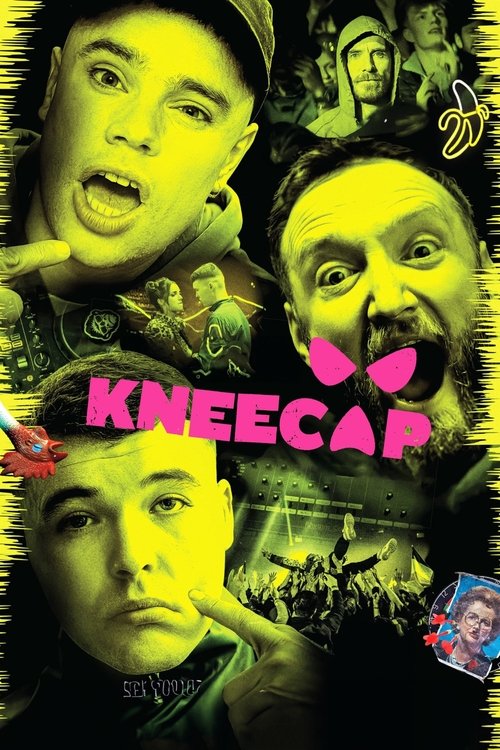
Rich Peppiatt's comedy-drama tells a loose, self-mythologising version of how the Belfast rap trio Kneecap began, with the band members playing themselves. Liam (Mo Chara) narrates; Naoise (Móglaí Bap) was raised on Irish by his father Arló (Michael Fassbender), a republican bomber who faked his death and is on the run; and JJ, a schoolteacher called in as a police interpreter, ends up producing their tracks and DJing in a balaclava as DJ Próvaí. The backdrop is the campaign for an Irish Language Act, and the foreground is drugs, sex, gigs and trouble with the police and with a gang of dissident republican vigilantes.
The messaging is the film's spine. Irish is presented as an identity the British state tried to stamp out and the band's music as resistance: Arló calls the school syllabus the curriculum of the colonizer, the arresting officer demands the 'Queen's English' with a sectarian slur, the tour poster calls Northern Ireland the 'Occupied Six', and a song shouts 'Get the Brits out'. Characters compare the language's status to skin colour, to the Native Americans of Westerns and to Black Americans, and the police are the main antagonists to the end.
The messaging is the film's spine. Irish is presented as an identity the British state tried to stamp out and the band's music as resistance: Arló calls the school syllabus the curriculum of the colonizer, the arresting officer demands the 'Queen's English' with a sectarian slur, the tour poster calls Northern Ireland the 'Occupied Six', and a song shouts 'Get the Brits out'. Characters compare the language's status to skin colour, to the Native Americans of Westerns and to Black Americans. At the climax a policeman beats Liam in a cell, orders him to speak English and reveals that he burned their studio, and Arló, back from hiding, tells his son he is the bullet fired for Irish freedom.
What keeps the score in the mild band is that the cast is all from Belfast, heroes and villains alike, and how freely the film mocks its own side. The dissident republicans are drug-dealing hypocrites, Arló's armed struggle is shown to have abandoned his family, a speech about inherited trauma turns out to be a pitch for stronger pills, mainstream language campaigners ask the band to stop, Liam's Protestant girlfriend pushes back on 'Brits out', and the narrator ends by doubting the bullet metaphor. Gender and sexuality are not part of the message, and the drugs and sex are played for comedy.
Score breakdown
Each category is scored 0 to 3: 0 absent or presence only, 1 brief, 2 recurring or plot-relevant, 3 central or dominant. Timestamps refer to the film's running time.
| Category | Score | What we saw |
|---|---|---|
| Content | ||
| A Ethnicity | 2 | Irish speakers are framed as a minority whose identity was suppressed, and the film compares their case to ethnicity several times. Scored 2, not 3: the identity at stake is national and linguistic, and the ethnicity analogies are a handful of lines. Liam's romance with Georgia, a Protestant whose aunt is in the police, is a mixed couple by culture only: 2 for a recurring supporting romance, no step up since they share a skin colour, and 1 off because the story makes the sectarian gap part of the plot and deals with it, so it reaches 1, below the messaging. No character is non-white.
|
| B Gender and feminism | 0 | The women are strong characters: Dolores faces down Arló (1:01:39), Caitlin is asked to lead the language campaign (0:34:41) and the West Belfast mothers rally behind the band (1:23:36). But gender is never argued. |
| C Sexuality and gender identity | 0 | No LGBTQ theme. The sex is frank and comic, including a role-play built on sectarian insults (0:35:20), and a drag performer appears beside the band in the end-credits video (1:41:30) without comment. |
| D Power and systems | 3 | The dominant frame. The British state and its police are cast as an occupying power that criminalises the community and its language, from a police helicopter breaking up a baptism at a Mass Rock to a sectarian arresting officer and a policeman's threat to silence the band, and finally a policeman who burned the studio and beats Liam in a cell.
|
| E Cultural and historical revision | 0 | The band members play themselves in a comic, embellished account of their own origins. Nothing established is recast to carry a message. |
| F Religion portrayal | 0 | Islam does not feature. Religion appears only as Catholic heritage and a drugs gag at Mass (0:02:55). |
| K Diverse cast | 0 | The cast is white and from Belfast, Catholic and Protestant, the communities the city really has, and the plot turns on the divide between them. Nobody's sexuality is part of the story; the drag performer in the end-credits video has no part. There is no mix beyond the setting. |
| Treatment | ||
| G Antagonist coding | 0 | The police are the main antagonists, drawn largely as sectarian enforcers of the British state, but that framing of the state against a community is scored under D. Heroes and villains alike are white Belfast men: the band on one side, the police and the dissident vigilantes of RRAD on the other, and Detective Ellis, who warns Naoise's mother that the band's music has drawn the wrong attention, is a woman. The moral sides do not divide along ethnicity or sex. |
| H Didacticism | 2 | Several characters state the message outright, in campaign speeches, Arló's slogans, JJ's pitch, a stage speech and the closing narration, though most are undercut by a joke soon after.
|
| I Message over story | 1 | The story mostly leads, with the band's rise, family and romance carrying the plot, but the climax lines the state up as the final villainneatly turns the studio fire from the dissidents' work into the police's, making the state the final villain.
|
| J Left-leaning politics framed as good | 2 | The Irish Language Act campaign is the film's cause and the unionist DUP appears only as the party blocking it and condemning the band; the lyrics also take swipes at suits and landlords. Scored 2, not 3: party politics stays in the background, and the earnest campaigners are mocked too.
|
How the number is reached
- Categories A to K add up to 10 of 33, which gives 3.0 (10 ÷ 33 × 10, rounded to the nearest 0.5).
- Counterweight −0.5: the film mocks its own side: the dissident republicans are drug-dealing hypocrites (1:15:44), Arló's armed struggle is shown to have abandoned his family (1:01:27), the trauma speech is a pitch for stronger pills (0:22:22), language campaigners ask the band to stop and call the dodo analogy terrible (1:06:01, 1:06:54), Georgia's objection to 'Brits out' gets a hearing (0:58:16), and the narrator doubts the bullet metaphor (1:38:18). The core message about the language and the state is never questioned, which keeps the deduction at 0.5.the dissident republicans are drug-dealing hypocrites (1:15:44) and one is exposed as an MI5 informer (1:35:32); Arló's armed struggle is shown to have abandoned his family (1:01:27); the trauma speech is a pitch for stronger pills (0:22:22); language campaigners ask the band to stop and call the dodo analogy terrible (1:06:01, 1:06:54); the RTÉ snub grows in the retelling (1:23:52) when the stated reason was sex and drug references (1:22:21); Georgia's objection to 'Brits out' gets a hearing (0:58:16); and the narrator doubts the bullet metaphor (1:38:18). The core message about the language and the state is never questioned, which keeps the deduction at 0.5.
- Final rating 2.5, mild.
Considered, scored 0
- An all-white Belfast cast, Catholic and Protestant (0:23:57, 1:03:16), the communities the setting has and the plot turns on (K).
- The police as the main antagonists (0:07:45, 0:55:13): white men like the band, with a woman, Detective Ellis (0:49:48), among them, so scored under D rather than G.
- Dolores, Caitlin and the West Belfast mothers as strong women (1:01:39, 0:34:41, 1:23:36), with no argument about gender.
- The sectarian role-play in bed (0:35:20) and Liam's 'political' impotence (0:23:31), sex comedy rather than a statement.
- A drag performer beside the band in the end-credits video (1:41:30), shown without comment.
Evidence and confidence
Confidence: Medium. Full English (SDH) subtitles plus the forced track that translates the spoken Irish. Most of the rapping in Irish is not subtitled (for example 0:17:45, 0:39:31, 1:26:00), so only the English lines of those performances could be checked.
Category F definition: As in the rubric: Islam shown as a peaceful and tolerant religion, aligned with human rights, in a way that works as a corrective message.
Rubric version 3. Reviewed 18 November 2026.