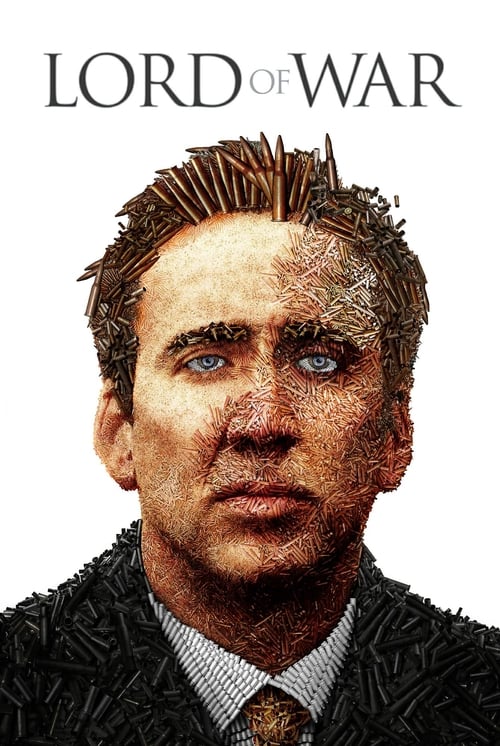
Woke rating
Lord of War
None or negligible
A darkly comic arms-dealer saga with an open anti-arms-trade message that implicates Western governments, but little identity politics and a cynical narrator who gets the best lines.
Andrew Niccol's satire follows Yuri Orlov (Nicolas Cage), a Ukrainian immigrant from Brighton Beach who becomes one of the world's biggest gun-runners, from Uzis in the 1980s through the sell-off of Soviet arsenals after 1991 to the civil wars of West Africa. Yuri narrates his own rise in a cool, wisecracking voice-over while Interpol agent Jack Valentine (Ethan Hawke) tries to catch him, and his wife and drug-prone younger brother slowly reckon with what he does.
The film is an argument against the arms trade and states it openly: an opening statistic on the world's firearms, Valentine's lecture that small arms are the real weapons of mass destruction, and a moral reckoning at home. Western governments are implicated from early on, through an American colonel who skims surplus munitions and a rival dealer grown rich selling for the CIA, and the ending takes that thread further. Ethnicity comes up once, in a line that the West ignored Africa's wars because it had a 'white war' in Yugoslavia.
The film is an argument against the arms trade and states it openly: an opening statistic on the world's firearms, Valentine's lecture that small arms are the real weapons of mass destruction, and Ava's discovery that the guns that killed her parents came from men like her husband. Western governments are implicated from early on, through an American colonel who skims surplus munitions and a rival dealer grown rich selling for the CIA, and the ending makes that the punchline: after his arrest Yuri tells Valentine that the biggest arms dealer in the world is the President of the United States, who needs freelancers to arm forces he cannot be seen arming, and Yuri walks free. Ethnicity comes up once, in a line that the West ignored Africa's wars because it had a 'white war' in Yugoslavia.
What keeps the score low is that this is not identity messaging, and the case against the arms trade is not partisan. Ethnicity, gender and sexuality barely feature, and the satire cuts in every direction: Yuri gets the sharpest lines in his own defence, the narration mocks leftists, rightists and the 'freedom fighter' labels of every faction alike, Valentine is driven partly by glory, and the African dictators who buy from Yuri are sadistic customers with their own motives, not victims.
Score breakdown
Each category is scored 0 to 3: 0 absent or presence only, 1 brief, 2 recurring or plot-relevant, 3 central or dominant. Timestamps refer to the film's running time.
| Category | Score | What we saw |
|---|---|---|
| Content | ||
| A Ethnicity | 1 | Ethnicity comes up once, as a line about Western indifference to Africa's wars. The African characters with real parts, the Liberian dictator Baptiste and his son, are sadistic customers, not flawless victims, and Yuri and Ava are a white couple from the same Brighton Beach neighbourhood (0:05:04, 0:28:45), so no mixed couple appears.
|
| B Gender and feminism | 0 | Ava is a model and trophy wife who becomes the voice of conscience and walks out with their son, but the film makes no point about gender. |
| C Sexuality and gender identity | 0 | No LGBTQ content. Yuri's womanising and Vitaly's drug-fuelled partying are shown as vices, not advocated. |
| D Power and systems | 0 | The film indicts the arms trade and its customers for arming 'the poorest people on the planet' against each other, and implicates Western governments along the way, a thread the ending drives home, and the ending frees Yuri because the US government needs freelancers to supply forces it cannot be seen supplying. The target is a trade and its official patrons, not the oppression of an identity group, so it is counted under J. |
| E Cultural and historical revision | 0 | An original screenplay. Baptiste is a fictional president of a real country, not a recast established character, and the period history (the end of the Cold War, the post-Soviet arms sell-off) is told straight. |
| F Religion portrayal | 0 | Islam is not portrayed. Muslims come up only as one more customer group in a wisecrack about Yuri's client list. |
| K Diverse cast | 0 | The leads are white: Yuri's Ukrainian immigrant family, Ava, Valentine and the arms dealers of the Cold War's end. The main non-white characters are the Liberian dictator and his son and the African fighters around them, villains and the setting of the West African wars, so under the rubric they do not add to a mixed cast. No character's sexuality is at issue, and the family's pretended Jewishness is a joke. |
| Treatment | ||
| G Antagonist coding | 0 | The moral sides do not divide along ethnicity or sex. The wrongdoers are Yuri himself, a rival dealer, an American colonel and a sadistic Liberian dictator and his son, each with clear motives, and the man hunting Yuri, Valentine, is a white man too. Ava becomes the voice of conscience, but she is set against her husband's trade, not against white men. The power behind the trade stays facelessThe US government that frees Yuri stays faceless, and that is counted under J. |
| H Didacticism | 0 | Several scenes state a message directly: the opening statistic, Valentine's lectures on small arms and their victims, a moral confrontation at home and a closing speech, Ava's 'it's wrong', and Yuri's closing speech about the US President. The message is against the arms trade and Western complicity, general politics counted under J; no speech states an identity message. |
| I Message over story | 0 | The story leads. The film is built around its argument, but the plot moves through character choices, and Yuri's release is set up by earlier hints of official complicity (0:15:19, 0:42:45). |
| J Left-leaning politics framed as good | 2 | The film's open case against the arms trade belongs here: Valentine's lectures on small arms as the real weapons of mass destruction, and Western governments implicated from an American colonel skimming munitions to the endingYuri's closing speech naming the US President as the biggest arms dealer. Baptiste also gets one jab at the disputed 2000 US election. Scored 2, not 3: the case names no party, most of the film is Yuri's personal story, and the narration mocks left and right alike.
|
How the number is reached
- Categories A to K add up to 3 of 33, which gives 1.0 (3 ÷ 33 × 10, rounded to the nearest 0.5).
- Counterweight −0.5: the film gives the other side a real hearing and spares no one: Yuri's case for himself is put wittily and at length (1:03:30, 1:15:34, 1:28:11), the narration mocks leftists, rightists and every faction's noble names (0:43:08, 1:40:16), Valentine is driven partly by glory (0:21:52), and the African leaders are sadistic customers with their own motives rather than victims (0:53:30).
- Final rating 0.5, none or negligible.
Considered, scored 0
- Andre Baptiste and his son, the African leaders who buy from Yuri (0:54:30), drawn as sadistic villains rather than flawless victims (A, K).
- West African settings, child soldiers and crowds stripping a cargo plane (0:58:09, 1:13:43), the backdrop of the trade rather than a statement about ethnicity.
- Two young Liberian women left in Yuri's bed as a 'welcome present' (0:56:04, 0:56:41), a scene framed around the risk of AIDS; a brief encounter, not a couple.
- The Orlovs' pretended Jewish identity and the Catholic mother's exasperation with it (0:05:32, 0:06:02), played for comedy.
- Ava's lament that all she has ever been is pretty (1:28:41), a character's self-doubt rather than a point about women.
- Passing mentions of Muslims and Osama bin Laden (0:16:45, 0:17:17), jokes about the client list, not a portrayal of Islam.
- Yuri and Ava, both from Brighton Beach (0:28:45), a white couple from the same neighbourhood (A).
Evidence and confidence
Confidence: Medium. The file has no English text subtitles, so the dialogue comes from a transcript of the English audio. It covers the whole film but garbles some names (Ava often comes out as 'Eva', Vitaly as 'Vitale') and a few lines, and leaves short Russian, Spanish and French exchanges untranslated (for example 0:05:53, 0:23:52, 1:42:31). The on-screen text just before the credits, somewhere between 1:55:30 and 1:56:30, was not seen.
Category F definition: As in the rubric: Islam shown as a peaceful and tolerant religion, aligned with human rights, in a way that works as a corrective message.
Noted, not scored: Some points cut the other way: the narration mocks communism's 'redistribution of wealth' (0:41:29) and the 'freedom fighter' labels of African factions (1:40:16), and Valentine's refusal to break the law to catch Yuri is presented as integrity (0:49:00, 1:14:13).
Rubric version 3. Reviewed 18 November 2026.