Woke rating
Operation Mincemeat
None or negligible
A wartime deception drama with almost no progressive messaging: its one nod is a capable woman who wants a real part in the operation, played as character rather than argument.
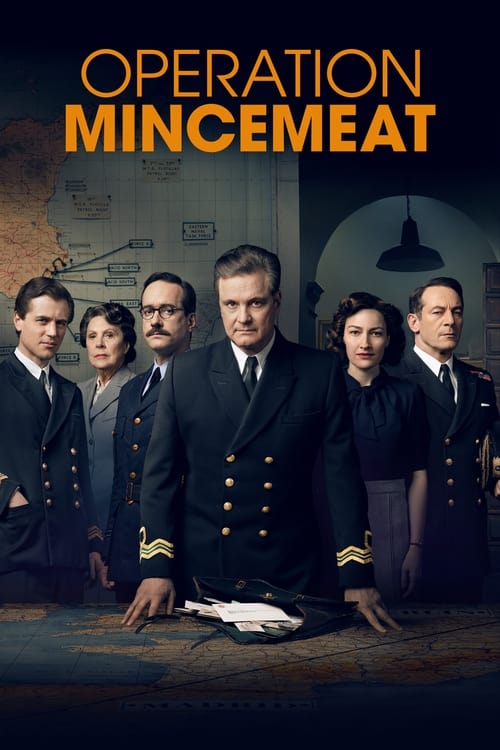
John Madden's drama recreates the 1943 deception in which British intelligence floated a dead man, dressed as a Royal Marine officer and carrying forged letters, ashore in Spain to persuade Hitler that the Allies would land in Greece rather than Sicily. Ewen Montagu (Colin Firth) and Charles Cholmondeley (Matthew Macfadyen) invent a whole life for 'Major William Martin' with the help of the clerk Jean Leslie (Kelly Macdonald) and the secretary Hester Leggett (Penelope Wilton), while Ian Fleming narrates. Most of the film is procedure, with a personal tangle among the team running alongside.
The rubric finds very little. Jean, a widowed clerk, offers her photograph for the dead man's fictional fiancée in exchange for a seat at the table, and becomes a full member of the team; later in the film she chooses a war of her own. Montagu is Jewish and has sent his family to America for fear of a Nazi invasion, MI5 suspects his brother Ivor of spying for Moscow, and one German agent is noted to be part Jewish. All of this is period detail or plot machinery, not commentary.
The rubric finds very little. Jean, a widowed clerk, offers her photograph for the dead man's fictional fiancée in exchange for a seat at the table, and becomes a full member of the team; after a mysterious agent threatens her at gunpoint, she leaves to join Special Operations and hopes to serve overseas. Montagu is Jewish and has sent his family to America for fear of a Nazi invasion, MI5 suspects his brother Ivor of spying for Moscow, and one German agent is noted to be part Jewish. All of this is period detail or plot machinery, not commentary.
The score stays at the bottom of the scale because nothing is argued. The enemy is the Nazi war machine, the obstacle at home is a cautious admiral with professional reasons for his doubts, and the British establishment, Churchill included, is drawn sympathetically. Where the film adds drama, in the team's private livesin the romance between Montagu and Jean and Cholmondeley's secret deal with Godfrey, it serves character, not a message.
Score breakdown
Each category is scored 0 to 3: 0 absent or presence only, 1 brief, 2 recurring or plot-relevant, 3 central or dominant. Timestamps refer to the film's running time.
| Category | Score | What we saw |
|---|---|---|
| Content | ||
| A Ethnicity | 0 | Ethnicity is never a theme. Jean dances with a Black American serviceman, one partner among many at a crowded club (0:36:30), without comment; antisemitism appears only as the historical Nazi threat (0:09:53, 0:50:13). The attachment between Montagu, who is Jewish, and Jean never becomes a couple: he is married and nothing is acted on, and both are British of the same milieu. |
| B Gender and feminism | 1 | A light thread: Jean, a widowed clerk, wants a real part in the operation and gets one, and later leaves to serve overseas. It is shown through character, never argued, and fits the period.
|
| C Sexuality and gender identity | 0 | No LGBTQ+ characters or themes. |
| D Power and systems | 0 | MI5 suspects Montagu's brother Ivor of spying for Moscow (0:40:44, 0:44:58), but this is wartime security drama: the film neither clears Ivor nor frames the suspicion as persecution. Using a dead vagrant's body is weighed as a moral cost to his grieving sister (0:47:46), not as a critique of class or the state. |
| E Cultural and historical revision | 0 | Based on the real 1943 operation. The film builds personal drama around it, a romantic tangle and a question of trust within the teamincluding the romance between Montagu and Jean and Cholmondeley's deal to report on Montagu, but none of it carries a message, and the casting is period-faithful. |
| F Religion portrayal | 0 | Islam does not feature. Christian scripture and prayer are treated with respect (1:16:26, 1:17:11). |
| K Diverse cast | 0 | The cast is white and British, with a few Spanish and German parts in the scenes abroad. Montagu's Jewish family is part of the true story, and the Black serviceman at the club is a dance partner in a crowd. The cast is essentially one group. |
| Treatment | ||
| G Antagonist coding | 0 | The enemy is the Nazi war machine, and the heroes are mostly British men too, so the moral sides do not divide along ethnicity or sex. The obstacle at home, Admiral Godfrey, opposes the plan for professional reasons: if it is detected, it would expose every other deception (0:44:35). |
| H Didacticism | 0 | No speeches carry a social message. Fleming's narration about a hidden war of deception (0:00:49, 0:24:59) is about spycraft, not politics. |
| I Message over story | 0 | The story follows the operation step by step, and none of its turns bends toward a message or the cast. |
| J Left-leaning politics framed as good | 0 | No left-leaning politics are framed as good. Ivor Montagu's brief socialist membership is mentioned only as a security worry (1:11:00), and Churchill and the British establishment are drawn sympathetically. |
How the number is reached
- Categories A to K add up to 1 of 33, which gives 0.5 (1 ÷ 33 × 10, rounded to the nearest 0.5).
- No counterweight: There is too little progressive messaging to mock or complicate; the one light thread is not argued.
- Final rating 0.5, none or negligible.
Considered, scored 0
- Jean dancing with a Black American serviceman at a club (0:36:30), one partner among many, shown without comment; not a couple.
- Montagu's Jewish family sent to America for fear of a Nazi invasion (0:09:53) and a German agent's Jewish ancestry (0:50:13), historical context from the true story rather than commentary (A, K).
- MI5's suspicion of Ivor Montagu as a communist spy (0:44:58, 1:10:35), plot machinery the film neither endorses nor frames as persecution.
- The use of a dead vagrant's body and his sister's angry grief (0:23:42, 0:47:46), handled as the operation's moral cost, not as a class critique.
- The growing attachment between Montagu and Jean (1:07:44), handled as personal drama about a married man's feelings; it never becomes a couple, so it is not scored as a mixed one (A).
Evidence and confidence
Confidence: Medium. The file has no English text subtitles, so the dialogue comes from a transcript of the audio. The transcript breaks down from about 1:27:05 to 1:33:25, where it repeats two lines in a loop, so roughly six minutes of dialogue in the Spain and London scenes were not heard; the picture from that stretch shows nothing relevant to the rubric. The transcript also garbles some names, and the Spanish dialogue in Huelva comes through in English (1:20:57 to 1:24:03).
Category F definition: As in the rubric: Islam shown as a peaceful and tolerant religion, aligned with human rights, in a way that works as a corrective message.
Noted, not scored: Patriotic duty and Christian faith are shown sympathetically: Montagu is told his duty is to his family and his country (0:11:12), scripture is read over the body at sea (1:16:26), and the team pray to St. Jude for Major Martin and the mission (1:17:11).
Rubric version 3. Reviewed 17 November 2026.