Woke rating
Ordinary Angels
None or negligible
A true-story drama about a hairdresser who rallies a city to help a sick girl; its only social edge is a brief jab at medical bills, and identity is never discussed.
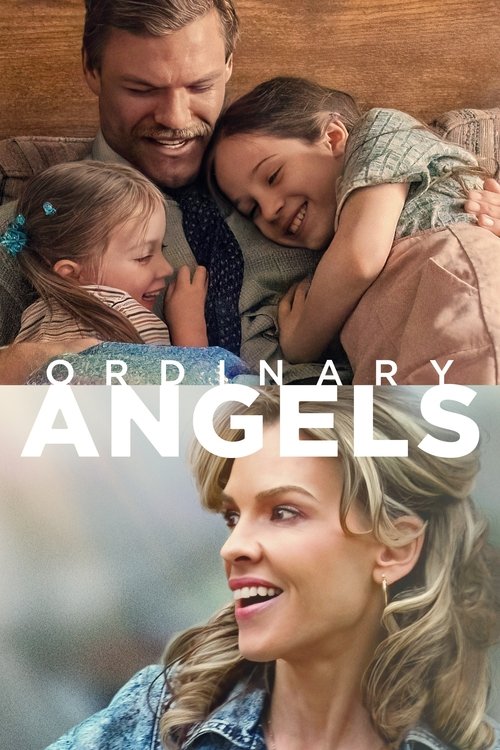
Jon Gunn's film is based on a true story set in Louisville, Kentucky. Sharon Stevens (Hilary Swank), a hard-drinking hairdresser, reads about Ed Schmitt (Alan Ritchson), a roofer whose wife has just died and whose five-year-old daughter Michelle needs a liver transplant. Sharon throws herself into fundraising and the family's paperwork, and her pushiness grates on the proud, reserved Ed.
The only social critique is medical debt. The family has no health insurance, the bills run past $400,000, and in one scene Sharon tells a hospital billing officer that they charged the mother so much to die that her daughter must die too. The scene ends in a personal appeal rather than a crusade, and the film never turns it into an argument about the system.
The only social critique is medical debt. The family has no health insurance, the bills run past $400,000, and in one scene Sharon tells a hospital billing officer that they charged the mother so much to die that her daughter must die too. The hospital wipes the bill, and the film never turns the episode into an argument about the system.
What keeps the score at the bottom is that the film's values are faith, charity and neighbourliness, not identity. A pastor challenges his congregation to help, Ed's lost faith is a thread, Sharon's recovery from drink is another, and the climax turns on strangers pitching inthe climax has a church, a veteran helicopter pilot and hundreds of strangers clearing a car park in a blizzard. The one point that scores is Sharon's Black business partner, Rose, drawn as the ideal friend who is always in the right; nothing is said about sex, ethnicity or sexuality.
Score breakdown
Each category is scored 0 to 3: 0 absent or presence only, 1 brief, 2 recurring or plot-relevant, 3 central or dominant. Timestamps refer to the film's running time.
| Category | Score | What we saw |
|---|---|---|
| Content | ||
| A Ethnicity | 1 | Ethnicity never comes up, and no mixed couple appears. Sharon's best friend and business partner Rose, who is Black, is drawn as the ideal friend: loyal, generous and always in the right, from dropping Sharon at her first meeting about her drinking to calling out her neglect of the salon. It is a supporting part with a handful of scenes, so it scores 1. Rose's large family helps at the fundraiser without comment.
|
| B Gender and feminism | 0 | Sharon is the driving force and Ed the reluctant one, but nothing is made of it as a point about the sexes. Ed's wish to provide for his own children is treated with sympathy (0:58:57), and Sharon's past as a wife left with a young son is backstory (0:59:38). |
| C Sexuality and gender identity | 0 | No LGBTQ+ content. |
| D Power and systems | 0 | Medical debt drives the first half: no insurance (0:24:20), a bill of more than $400,000 (0:35:09) and one sharp scene at the hospital billing office (1:04:01). It stays one family's hardship, tied to no group and answered by persuasion and charity rather than framed as an argument about the system, and the hospital relents (1:05:21). |
| E Cultural and historical revision | 0 | Based on a true story; a closing photo of the real Sharon is shown (1:52:30). Nothing observed recasts the real people or the history to carry a message. |
| F Religion portrayal | 0 | Islam does not feature. |
| K Diverse cast | 0 | Set in Louisville, Kentucky, whose real mix accounts for the few non-white characters: Rose and her family, Michelle's doctor and a TV reporter. The main cast is white, Rose is the one non-white character with a real part, nobody is gay, and the faith shown is the local Christian church. |
| Treatment | ||
| G Antagonist coding | 0 | There is no villain. The hospital billing officer and the business owners Sharon pesters are obstacles who are given a hearing and end up helpingend up helping: the bill is wiped and a businessman lends five planes. |
| H Didacticism | 0 | The speeches are about purpose, faith and helping others: a recovering drinker's advice to find a reason bigger than yourself (0:08:02) and the pastor's challenge to the congregation (0:13:01). Sharon's plea to the hospital is a personal appeal, not a lecture about the system. |
| I Message over story | 0 | The story leads. The plot is the race to raise money and to keep Michelle alive until a liver is found, and none of its turns bends toward a social message. |
| J Left-leaning politics framed as good | 0 | No politics, left or right. The medical bills are one family's hardship rather than a case for policy, and the film's answers are prayer, church, charity and neighbours, not government. |
How the number is reached
- Categories A to K add up to 1 of 33, which gives 0.5 (1 ÷ 33 × 10, rounded to the nearest 0.5).
- No counterweight: None applies to the one point that scores, the idealised best friend. The film does complicate its one critique, which scores nothing: the billing officer explains why the hospital cannot simply cancel the debt (1:04:13) and is moved by Sharon's appealthen wipes the bill (1:05:21), and planes come from companies and business owners (1:09:29).
- Final rating 0.5, none or negligible.
Considered, scored 0
- Rose's many cousins who turn out for the hair-a-thon (0:27:02, 0:15:30, 1:31:30), extras shown without comment.
- Sharon as the pushy organiser and Ed as the proud, reluctant father (0:58:45), a clash of temperaments rather than a point about the sexes.
- Sharon's remark to her estranged son that being a single mom isn't easy (0:53:25), part of an apology rather than a statement about women.
- Michelle's doctor, Dr. Ghorbani (1:42:27), and the TV reporter Amy Chan (1:16:45), small parts that fit a city setting (K).
Evidence and confidence
Confidence: Medium. Full English subtitles from the embedded track. The HDR picture is dark but readable, and no gaps in the dialogue were found.
Category F definition: As in the rubric: Islam shown as a peaceful and tolerant religion, aligned with human rights, in a way that works as a corrective message.
Noted, not scored: Christian faith runs through the film: a pastor's eulogy challenges the congregation to help the family (0:13:01), Ed's mother calls Sharon's gift an answer to prayer (0:31:21), Ed's older daughter coaxes him back to prayer and he returns to church (1:25:14, 1:26:18), and a pastor helps in the climaxPastor Dave Stone offers his church's car park as a landing site and calls his congregation out with shovels (1:41:35). Help comes from charity, business and neighbours rather than the state: a hair-a-thon, corporate jet owners (1:09:29) and ordinary people in the climaxstrangers who clear snow and lay down their coats so the helicopter can land (1:47:58). Sharon's drinking is treated as a problem to face through AA (0:08:23), and she ends up standing up at a meeting as an alcoholic (1:23:37).
Rubric version 3. Reviewed 18 November 2026.