Woke rating
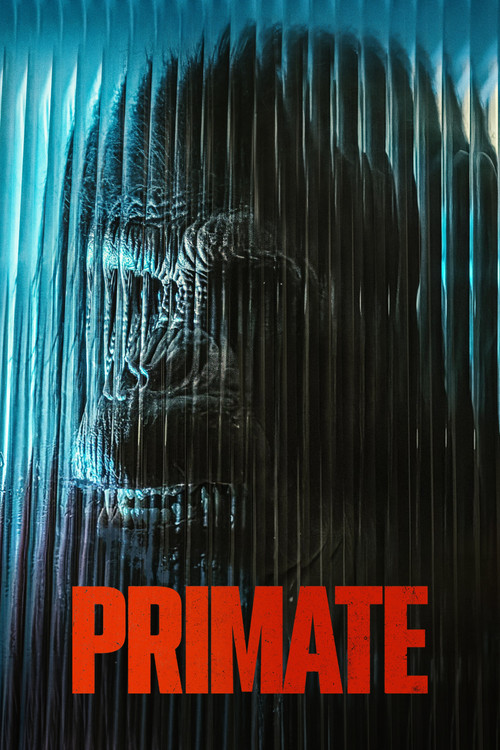
Primate
None or negligible
A lean creature feature about a family's pet chimpanzee turning on a group of young women in a Hawaiian clifftop house, with no progressive messaging; a brief flirtation across ethnic lines passes without comment.
Johannes Roberts's horror film follows Lucy, back from college for the summer with her friend Kate and Kate's new friend Hannah, to her family's glass house above the sea in Hawaii. Her father, a deaf novelist who speaks in sign language, leaves for a book launch, and the house is left to the young people and Ben, the chimpanzee Lucy's late mother, a linguist, raised to communicate with people. A mongoose gets into Ben's enclosure and bites him, and what follows is a siege around the swimming poolrabies turns him into a killer who traps the survivors in the pool, which he cannot enter.
There is very little here for the rubric. Hannah's brief flirtation with Kate's brother Nick, who appears to be of East Asian descent, on the first night is a passing moment between friends of the same background, and Hawaii accounts for the young cast's mix. The deaf father is simply a character, the young women are the genre's usual leads and victims, and the two crude young men they met on the plane exist to walk into danger, not to make a point about men.
The score stays at zero because nothing is argued. The threat is a sick animal with no ideology, the human conflicts are a teenage spat and a busy father who is never home, and the dialogue has no speeches of any kind.
Score breakdown
Each category is scored 0 to 3: 0 absent or presence only, 1 brief, 2 recurring or plot-relevant, 3 central or dominant. Timestamps refer to the film's running time.
| Category | Score | What we saw |
|---|---|---|
| Content | ||
| A Ethnicity | 0 | The one pairing is Hannah's brief flirtation with Kate's brother Nick, who appears East Asian or mixed, on the first night: a background couple (1). They are college-age friends from the same circle, with no difference of culture or upbringing shown, so 1 comes off for a difference of skin colour only (0). Ethnicity is never mentioned and Nick dies soon after. |
| B Gender and feminism | 0 | The young women are the leads and the victims, as the genre usually has it, and nothing is framed through gender. The boys from the plane are crude (0:42:07) but are treated as fools, not as a statement about men. |
| C Sexuality and gender identity | 0 | No LGBTQ characters or themes. The only sexual content is a drunk prank voicemail inviting the boys over (0:22:25) and Hannah's flirtation with Nick. |
| D Power and systems | 0 | No institutions are criticised. The 911 dispatcher asks for an address (1:09:45) and the father's publisher pushes him to close a film deal (0:58:42), both plot mechanics. |
| E Cultural and historical revision | 0 | An original story; nothing established is recast. |
| F Religion portrayal | 0 | Religion does not feature, and Islam is not portrayed. |
| K Diverse cast | 0 | The young cast is mostly white, with Nick, who appears East Asian, and one or two friends of mixed appearance. On Hawaii, where the film is set, that mix is ordinary. No character is gay and religion does not feature; the father's deafness is not a matter for this category. |
| Treatment | ||
| G Antagonist coding | 0 | The antagonist is a rabid chimpanzee. Hannah's call to shoot him (0:32:25) is a quarrel among friends, and the two crude boys from the plane (0:42:07) are party guests who walk into danger, not villains. Nick and the girls' father are on the good side, so nothing lines up with ethnicity or sex. |
| H Didacticism | 0 | There are no speeches or lectures; most of the dialogue is screaming, warnings and short exchanges. |
| I Message over story | 0 | A contained survival story whose turns serve suspense; none bends toward a message or to serve the cast. |
| J Left-leaning politics framed as good | 0 | No politics appear, left or right. |
How the number is reached
- Categories A to K add up to 0 of 33, which gives 0.0 (0 ÷ 33 × 10, rounded to the nearest 0.5).
- No counterweight: None applies: there is no progressive messaging to complicate or mock.
- Final rating 0.0, none or negligible.
Considered, scored 0
- Hannah's flirtation with Nick, who appears East Asian or mixed (0:06:23, 0:24:23; seen at 0:13:30 and 0:21:30), a brief pairing of friends from the same circle with no cultural difference shown (A).
- A young cast that includes Nick and one or two friends of mixed appearance, an ordinary mix for Hawaii (K).
- Lucy's father is deaf and talks in sign language with his daughters (0:07:50, 0:19:30), shown as an ordinary part of the family without comment.
- Lucy's late mother, a linguistics professor who brought Ben home to study communication with chimps (0:13:47), a back-story rather than a message.
- A cast of young women who are both the leads and the victims, and two crude young men who walk into the house expecting sex (0:59:06), the genre's conventions rather than a point about the sexes.
- Lucy's crush on Nick, which her father nudges her to act on (0:08:53), a passing hint between two characters shown without comment.
- The father's absences for work (0:04:22, 0:09:18) and his apology at the end (1:22:43), a family theme rather than a social one.
- Keeping a chimp as a pet is questioned only in passing (0:32:37, 1:02:49), with no animal-rights argument.
Evidence and confidence
Confidence: Medium. Full English subtitles from the embedded track, with the forced track for the father's signed lines. Much of the film is dark, near-wordless stalking, and the HDR picture is very dim; characters' ethnicity was judged as well as the picture allows.
Category F definition: As in the rubric: Islam shown as a peaceful and tolerant religion, aligned with human rights, in a way that works as a corrective message.
Rubric version 3. Reviewed 18 November 2026.