Woke rating
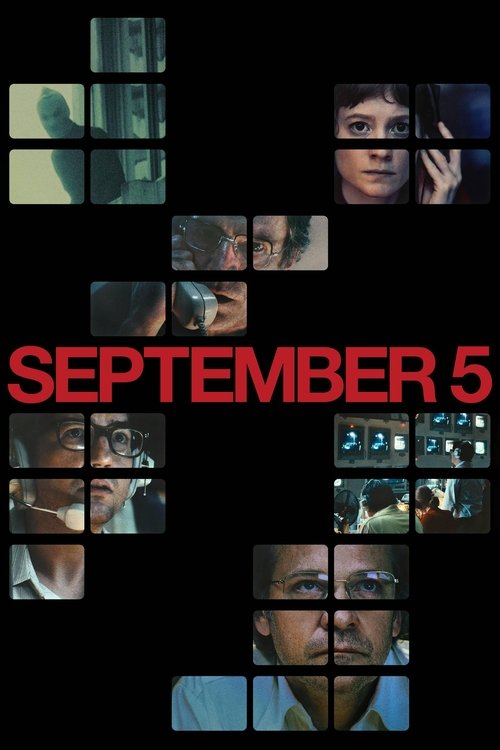
September 5
None or negligible
A tense control-room thriller about ABC Sports covering the Munich hostage crisis live; its few identity-related moments are a line or two each, and its real subject is the ethics of live news.
Tim Fehlbaum's film stays almost entirely inside ABC Sports' Munich studio on 5 September 1972, as a sports crew led by the young producer Geoff Mason finds itself covering the attack on the Israeli Olympic team live to the world. Marianne, a German translator, becomes the crew's ear on German radio and the police.
The messaging is slight. When a crew member swears about Arabs, a French technician with an Algerian mother objects and Peter Jennings warns the team to be careful, and later an Arab athlete is shown on a monitor expressing solidarity with the Israelis. A crew member's doubt about a female police negotiator gets one pointed reply. The German authorities are shown as unprepared, and the crew argues over sponsors and ratings, over whether to show a killing live, and over whether to air an unconfirmed report about the hostages that turns out to be false.
What keeps the score near zero is that each of these moments is a line or two, and the film's argument is about journalism, not identity. The one charged naming question is debated and settled on 'terrorists', and the focus stays on the hostages and their families.
Score breakdown
Each category is scored 0 to 3: 0 absent or presence only, 1 brief, 2 recurring or plot-relevant, 3 central or dominant. Timestamps refer to the film's running time.
| Category | Score | What we saw |
|---|---|---|
| Content | ||
| A Ethnicity | 1 | One exchange rebukes a crew member's swearing about Arabs, and an Arab athlete's statement of solidarity with the Israeli team is shown on a monitor. Jacques, the technician with an Algerian mother, is an ordinary crew member rather than a model, and no mixed couple appears.
|
| B Gender and feminism | 1 | One exchange: a crew member doubts the policewoman negotiating with the attackers and is told that being underestimated may help her. Marianne is otherwise a capable colleague shown without comment.
|
| C Sexuality and gender identity | 0 | No sexuality or gender-identity content. |
| D Power and systems | 0 | The German authorities are shown as unprepared and image-conscious (0:30:32, 0:58:51), and the network's scoop-chasing is questioned throughout (0:37:20), but as failures of competence and ethics, tied to no group and to no political side. |
| E Cultural and historical revision | 0 | A dramatisation of real events, with the anchors seen mainly through archive footage on the monitors. No established figure is recast by sex or ethnicity. |
| F Religion portrayal | 0 | Islam is not portrayed. The Arab athlete's statement, scored under A, is about solidarity, not religion. |
| K Diverse cast | 0 | A true story about the ABC Sports crew in Munich, mostly white American men, with Bader's Jewish background part of the real story and a German interpreter as the crew's ear. Jacques, a French technician with an Algerian mother, and Gary, a Black crew member with a few lines, are the only others with speaking parts, a small mix an Olympic broadcast centre would plausibly have. Nobody's sexuality is shown. |
| Treatment | ||
| G Antagonist coding | 0 | The antagonists are the attackers, seen at a distance and defined by their demands, and the German authorities, shown as inept. The crew member who swears about Arabs and the one who doubts the female negotiator are answered in a line and not cast as villains, and the heroes, Mason, Arledge and Bader, are white men too, so the sides do not divide by ethnicity or sex. |
| H Didacticism | 1 | Two one-line rebukes (about Arabs and about the female negotiator) state a point directly. There are no speeches.
|
| I Message over story | 0 | The story leads; the film follows the broadcast in close to real time. |
| J Left-leaning politics framed as good | 0 | No left or right politics are framed as good or bad; the debates are about journalism. |
How the number is reached
- Categories A to K add up to 3 of 33, which gives 1.0 (3 ÷ 33 × 10, rounded to the nearest 0.5).
- Counterweight −0.5: The film's one charged question gets both sides: Jennings calls 'terrorists' a loaded term and urges caution (0:32:26), a colleague answers with a definition that fits the attack (0:32:28), and the broadcast uses the word (0:39:30). The crew member who swore about Arabs is answered, not cast as a villain (0:31:51).
- Final rating 0.5, none or negligible.
Considered, scored 0
- Germany's Nazi past as historical context: the Dachau segment (0:08:08), Bader asking Marianne whether her parents 'didn't know either' (0:09:42), and a government spokesman's remark about old memories (1:18:34).
- Jewish identity among the crew and athletes, such as the banter over asking Spitz about the Holocaust (0:06:38), shown without a message.
- Marianne, a woman doing a key job in a mostly male control room, shown without comment, and a crew that includes a French technician with an Algerian mother (0:31:49) and a Black crew member, Gary (0:15:30), the mix an Olympic broadcast centre would plausibly have (K).
Evidence and confidence
Confidence: Medium. Full English subtitles. Some German-language exchanges are subtitled in the picture rather than on the subtitle track (for example 0:11:30), so a few may have been missed; the key German radio and police reports are relayed in English in the dialogue.
Category F definition: As in the rubric: Islam shown as a peaceful and tolerant religion, aligned with human rights, in a way that works as a corrective message.
Noted, not scored: The film settles the naming debate on 'terrorists' (0:32:28, 0:39:30) and keeps its focus on the Israeli hostages and their families; the attackers' cause appears only as their demand for the release of prisoners (0:23:13).
Rubric version 3. Reviewed 18 November 2026.