
Woke rating
Teenage Sex and Death at Camp Miasma
Mild
A dreamlike queer meta-slasher whose queer and trans themes run all through it, but which mocks Hollywood's appetite for 'woke' reboots and its own heroine's gender-theory jargon, and rarely preaches.
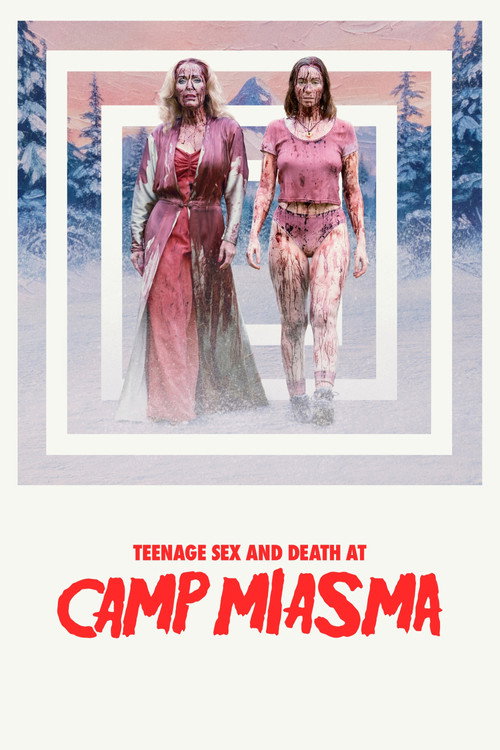
Jane Schoenbrun's horror comedy follows Kris (Hannah Einbinder), a queer art-house filmmaker hired to reboot Camp Miasma, an 1980s slasher franchise now seen as a problematic classic. She drives into the snowbound Northwest to meet Billy Presley (Gillian Anderson), the first film's final girl, who lives alone in the abandoned summer camp where it was shot. Over fried chicken and weed, and a night watching Billy's print of the original, the meeting turns into something stranger.
The messaging sits mostly with Kris. Her work explores queerness and monstrosity, the first Camp Miasma was her queer awakening, she uses she/they pronouns, is in a polyamorous relationship and calls the franchise blatantly transphobic. The original film, shown at length, gives its killer an origin as a gender-fluid child mocked and drowned by other campers, a legend one counselor flags as transphobic before it is told. As Kris grows closer to Billy, the film turns to her trouble with sex and a fantasy of transformation.
The messaging sits mostly with Kris. Her work explores queerness and monstrosity, the first Camp Miasma was her queer awakening, she uses she/they pronouns, is in a polyamorous relationship and calls the franchise blatantly transphobic. The original film, shown at length, gives its killer an origin as a gender-fluid child mocked and drowned by other campers, a legend one counselor flags as transphobic before it is told. Kris and Billy sleep together, and Billy coaxes Kris past her dissociation by letting her play out her fantasy of becoming a slasher victim, which Kris herself calls misogynistic. Kris acts out her own death in Billy's arms and the two leave together the next morning.
What keeps the score in the mild band is that the film mocks the messaging around its subject. The studio wants the origin story 'elevated, AKA woke', Kris herself sneers at studios that hire a queer person to paper over an ugly franchise, her theory-heavy debut is a running joke, and Billy waves away her talk of gender trouble: the original, she says, was about flesh and fluids. The queer and trans themes are explored through two flawed women rather than argued, nobody is held up as flawless, the men are comic bit parts rather than villains, and the politics are a few passing jabs.
Score breakdown
Each category is scored 0 to 3: 0 absent or presence only, 1 brief, 2 recurring or plot-relevant, 3 central or dominant. Timestamps refer to the film's running time.
| Category | Score | What we saw |
|---|---|---|
| Content | ||
| A Ethnicity | 0 | Ethnicity never comes up beyond Kris's passing mention of Mickey Mouse's blackface (counted under H). Kris's partner Mari is Black, but she is a brief part and the couple is not scored as mixed (see 'zeroed'). |
| B Gender and feminism | 1 | The slasher genre's treatment of women comes up in a few lines and in Billy's memory of a joyless first time, but the film reclaims the genre's tropes as erotic play rather than arguing a point about patriarchy.
|
| C Sexuality and gender identity | 2 | Queer identity and a trans allegory run through the film: Kris's queerness, pronouns and polyamory, her reading of slashers as queer, the franchise branded transphobic, a killer whose legend makes him a gender-fluid child drowned by bullies, and a turn towards sexual release, and Billy's lesson that Kris's sexual fantasies are 'all just play'. Scored 2, not 3: no queer character is drawn as flawless (Kris is self-absorbed and pretentious, Billy manipulative and unhinged), the themes are explored rather than argued, and the film itself mocks the queer-theory framing (see the counterweight).
|
| D Power and systems | 0 | Hollywood is drawn as cynical about old IP and its shareholders (0:24:16, 0:25:13), which is counted under J. The cover-up of the drowning in the original film's legend (0:47:07) belongs to the trans theme scored under C, not to a critique of a real institution. |
| E Cultural and historical revision | 0 | An original story. Camp Miasma is a fictional franchise that nods to real slashers such as Sleepaway Camp (0:38:51), and Little Death is an original character, so nothing established is recast. |
| F Religion portrayal | 0 | Islam does not appear. |
| K Diverse cast | 1 | Kris's and Billy's sexuality is what the plot turns on, so it is not counted here. Beyond them the cast is mostly white, with a few supporting characters who add ethnic and sexual variety the story does not need: Kris's Black partner Mari and Mari's bisexual boyfriend Thor. No one's religion comes up.
|
| Treatment | ||
| G Antagonist coding | 0 | The moral sides do not divide along sex or ethnicity. The men are bit parts: a crude studio executive doing an Austin Powers impression (1:16:46), a horny counselor in the original film (0:51:38) and a doom-saying local (0:43:20). Kris's female agent and executive are mocked just as much, and the two women at the centre are not set up as the good side: Billy orders Kris to stay the night (0:32:12), then steers her into a staged chase through the woods (1:32:47). |
| H Didacticism | 1 | Kris delivers one on-the-nose monologue and a few lines of academic jargon. They are in character and the film undercuts them at once, so 1.
|
| I Message over story | 0 | The dreamlike plot follows the characters' obsessions, and the queer allegory is the film's subject rather than something the story is bent to serve. The anachronistic aside in the 1980s film calling its own legend transphobic (0:44:43) is a joke, cut off at once. |
| J Left-leaning politics framed as good | 1 | A few passing jabs at rural conservatives and at capitalism, each a single line; Billy's gentle digs at vegan and gluten-free fads (0:18:02) cut the other way.
|
How the number is reached
- Categories A to K add up to 6 of 33, which gives 2.0 (6 ÷ 33 × 10, rounded to the nearest 0.5).
- Counterweight −0.5: The film mocks the messaging around its subject and does not flatter its heroine: Kris's agent says the studio wants the origin story 'elevated, AKA woke' (0:12:19); Kris herself mocks studios that hire a queer person to paper over a problematic franchise with a perfunctory message about gender (0:25:03); her debut, Psycho from the perspective of the shower curtain, is a joke that audiences mostly did not get (0:23:26, 0:23:41); Billy cuts her off for talking about her work instead of herself (0:25:20) and dismisses her talk of gender trouble in favour of 'flesh and fluids' (0:31:01); and Kris rolls her eyes at her own poly game nights (0:26:24), while the executives' 'oh, it's an allegory' (1:36:26) laughs at the film's own method.
- Final rating 1.5, mild.
Considered, scored 0
- Kris and her partner Mari, heard on the phone (0:06:52) and seen at the camp (1:34:30): a white and a Black American woman. A brief couple (1), minus 1 because they share a culture and differ only in skin colour, so 0 (A). Mari's relationship with Thor, white and bisexual, likewise.
- Little Death, the masked, wordless killer (0:56:30, 1:41:30): an original character whose legend makes him gender-fluid, so his casting is not scored under E or K.
- The counselors in the original 1980s film, among them a counselor of colour at the campfire (0:45:30): crude or horny genre types with small parts, so they do not add to the cast mix (K).
- The bond between Kris and BillyThe same-sex affair between Kris and Billy, a 29-year-old and a woman of about 60 (0:25:48, 0:38:19), and its sex scene (1:09:12), shown frankly; neither woman is drawn as flawless, and the themes around it are scored under C.
- An on-screen article calling Camp Miasma a problematic classic (0:05:30), part of the set-up the film satirises.
Evidence and confidence
Confidence: Medium. Full English subtitles from the embedded track. The film has long wordless stretches (the opening minutes, Kris's arrival at the camp, much of the climax and the last minutes before the credits), which were judged from the picture. Much of the picture is dark, so some minor characters in the original 1980s film could not be told apart.
Category F definition: As in the rubric: Islam shown as a peaceful and tolerant religion, aligned with human rights, in a way that works as a corrective message.
Rubric version 3. Reviewed 20 November 2026.