Woke rating
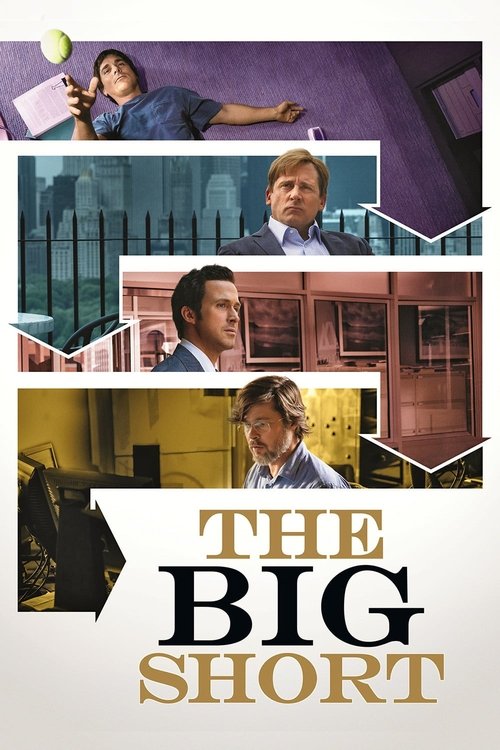
The Big Short
Mild
A caustic, fourth-wall-breaking comedy about the 2008 crash whose anti-Wall Street message is loud and central, though identity politics barely appear and its money-making heroes are shown as compromised too.
Adam McKay's adaptation of Michael Lewis's book follows the few investors who bet against the American housing market before 2008: the reclusive fund manager Michael Burry (Christian Bale), the angry hedge-fund boss Mark Baum (Steve Carell) and his team, the Deutsche Bank salesman Jared Vennett (Ryan Gosling), who narrates to camera, and two young fund managers helped by the retired trader Ben Rickert (Brad Pitt). Most of the film is a finance procedural, broken up by asides to the audience and celebrity cameos that explain the jargon.
The message is an indictment of Wall Street and its watchdogs. Banks, rating agencies, mortgage brokers and the SEC are shown as greedy, stupid or corrupt, and the film repeatedly names the victims: working people ripped off by fees, borrowers given loans they cannot repay, immigrants targeted because they sign without asking questions. Baum and Rickert put the case in speeches, and the closing narration steps outside the story to editorialise about what came after. Ethnicity comes up only in a few lines and jokes; gender and sexuality not at all.
The message is an indictment of Wall Street and its watchdogs. Banks, rating agencies, mortgage brokers and the SEC are shown as greedy, stupid or corrupt, and the film repeatedly names the victims: working people ripped off by fees, borrowers given loans they cannot repay, immigrants targeted because they sign without asking questions. Baum and Rickert put the case in speeches, and after the bailout Vennett's narration first pretends the bankers went to jail and the banks were broken up, then says 'just kidding': the banks paid themselves bonuses, lobbied against reform and blamed immigrants, the poor and teachers. Ethnicity comes up only in a few lines and jokes; gender and sexuality not at all.
What keeps the score mild is that the messaging is economic rather than about identity, and that the film does not flatter its heroes. They are financiers who profit from the collapse and say so; an S&P manager calls Baum a hypocrite, Vennett argues the system runs more on stupidity than fraud, and the case for the bailout gets a line. Most content categories score zero.
Score breakdown
Each category is scored 0 to 3: 0 absent or presence only, 1 brief, 2 recurring or plot-relevant, 3 central or dominant. Timestamps refer to the film's running time.
| Category | Score | What we saw |
|---|---|---|
| Content | ||
| A Ethnicity | 1 | Ethnicity appears only in passing: a salesman's racist joke about his own quant that the quant deflates, a broker who targets immigrants, a jab at the convention's white crowd, and the closing remarks about immigrants being blamed. No non-white character is held up as flawless: the quant is a foil for a joke, the Asian CDO manager is one of the bankers the film despises, and the Black executive over Baum's fund has a small part. No mixed couple appears.
|
| B Gender and feminism | 0 | Gender is not argued. The women in finance (an S&P manager, the Morgan Stanley executive over Baum's fund) are shown without comment, and the bubble-bath cameo and strip-club scenes are gags, not statements. |
| C Sexuality and gender identity | 0 | No LGBTQ themes. Vennett's crude sales line about making love to his client (0:55:42) is banter. |
| D Power and systems | 1 | The film's indictment of the banks, rating agencies, brokers and regulators is general politics, counted under J. What stays here is the predatory lending framed as aimed at a group: a Miami broker boasts that he targets immigrants because they sign without understanding the rates. One scene, so 1.
|
| E Cultural and historical revision | 0 | Adapted from Michael Lewis's 2010 book about real traders, some under changed names. The film flags its own departures from fact (0:40:17) and insists on its accuracy elsewhere (1:50:13); nothing is recast to carry a message. |
| F Religion portrayal | 0 | Islam does not come up. A banker's joke about shooting terrorists at a gun range (1:15:25) is the only nod in that direction. |
| K Diverse cast | 0 | A true story about Wall Street in the 2000s, and the cast is essentially the white men it had: the traders, their teams and the bankers. Baum's Jewish upbringing is the real man's, and the few others, such as the Chinese quant, the Asian CDO manager and the Black Morgan Stanley executive, have small parts or are there to be mocked. No character's sexuality is at issue. |
| Treatment | ||
| G Antagonist coding | 0 | Heroes and villains alike are mostly white men: the investors who see the crash coming are white men, and so are most of the bankers, brokers and raters they bet against, alongside an Asian CDO managerMr. Chau, an Asian CDO manager drawn as a smug crook (1:22:54) and the S&P manager, a woman. No minority or female character stands out on the good side against white villains. The antagonist is Wall Street as a class, called crooks (1:37:37), and coding by class counts under J. The one jab at the convention's white crowd (1:12:13) is scored under A. |
| H Didacticism | 1 | The film lectures openly and often, through Vennett's narration to camera, Baum's rants and a climactic speech and Rickert's rebuke, but nearly all of it is about Wall Street and counts under J. Only a line in the closing editorialthe closing narration's line that the banks blamed immigrants, the poor and teachers states a point scored under A to F, which keeps it at 1.
|
| I Message over story | 0 | The story leads and follows the real trades. Baum is built as the film's conscience, his debate is staged as realists against fools (1:50:04), and the ending steps out of the story to editorialise, but all in service of the case against Wall Street, which counts under J. |
| J Left-leaning politics framed as good | 3 | The indictment of Wall Street and its watchdogs is the film's dominant message. Banks, rating agencies, brokers and regulators are shown defrauding ordinary people and getting away with it, the critics are framed as right and regulation and prosecution as what should have happened, Greenspan is named as an architect of the crisis, and the case is put in lectures to camera, rants and speeches, ending with a closing editorial that jabs at those who blamed immigrants, the poor and teachers. Scored 3: it is central, repeated and argued outright, though no party is named and the anger at the bailout cuts across left and right.
|
How the number is reached
- Categories A to K add up to 6 of 33, which gives 2.0 (6 ÷ 33 × 10, rounded to the nearest 0.5).
- Counterweight −0.5: The film does not flatter its own side: an S&P manager calls Baum a hypocrite for holding swaps (1:06:50), Vennett argues the system runs more on stupidity than fraud (1:09:45) and says outright he is not the hero as he cashes his bonus (1:48:33), Baum's partners remind him of his duty to clients (1:44:40) and warn that selling makes them like the rest (2:00:53), a laid-off banker gets a moment of sympathy (1:55:02), and the case that the bailout was necessary gets a hearing (1:59:13, 1:59:20). The core indictment of the banks is never questioned, which keeps the deduction at 0.5.
- Final rating 1.5, mild.
Considered, scored 0
- Kathy Tao, the Black Morgan Stanley executive over Baum's fund (1:43:30), and Georgia Hale at S&P (1:04:30), women in finance shown without comment (A, K).
- Vennett's Chinese quant, the butt of his sales joke (0:31:37), and Mr. Chau, the Asian CDO manager Baum takes for a crook (1:22:54): neither flawless nor favourably drawn (A, K).
- Margot Robbie in a bubble bath and Selena Gomez at a blackjack table as celebrity explainers (0:13:42, 1:26:08), and the strip-club scenes (0:53:30), played as gags.
- Burry's glass eye and social awkwardness (0:06:06) and Baum's Talmud-school childhood (0:16:11), character detail.
- Vennett's crude sales banter about making love to his client (0:55:42).
- A banker's joke about shooting terrorists at the gun range (1:15:25).
Evidence and confidence
Confidence: Medium. The file has no English text subtitles, so the dialogue comes from a transcript of the English audio. It covers the whole film but garbles names (Burry often comes out as 'Barry' or 'Berry', Baum as 'Balm') and some overlapping lines, and loops on one phrase in two places (0:18:56 to 0:19:15, 1:30:56 to 1:31:08). The film's on-screen quotes and closing title cards are not in the transcript; only those at 1:34:30, 2:02:30 and 2:03:30 were read. The last five minutes are end credits.
Category F definition: As in the rubric: Islam shown as a peaceful and tolerant religion, aligned with human rights, in a way that works as a corrective message.
Noted, not scored: Some points cut across the usual lines: the film blames regulators and the Fed as well as the banks (1:16:04, 1:49:55), and its anger at the bailout (1:59:23) is shared by populists on the right.
Rubric version 3. Reviewed 18 November 2026.