Woke rating
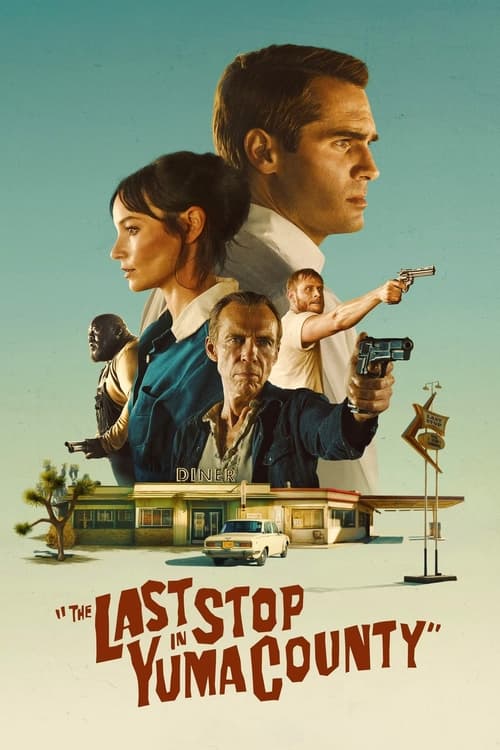
The Last Stop in Yuma County
None or negligible
A tense period crime thriller about bank robbers, hostages and stolen cash at a desert rest stop, with no progressive messaging: its subject is greed and bad luck, not politics.
Francis Galluppi's debut feature is set at a gas station and diner in the Arizona desert, in what looks like the 1970s. The pumps are dry, so a travelling knife salesman (Jim Cummings) waits in the diner, where Charlotte (Jocelin Donahue), the sheriff's wife, serves coffee. Two men in a green Pinto pull in, and a news report has just described the getaway car from a bank robbery that morning. As more stranded travellers arrive, the wait turns into a hostage stand-off over the money.
There is almost nothing here for the rubric to find. The cast is mostly white; Vernon, the Black owner of the gas station, and a Native American customer in a cowboy hat appear without comment, apart from one exchange of insults in the stand-off. A young would-be outlaw jokes that a stranger looks like the cross-dresser from Psycho. The sheriff and his deputy are small-town lawmen drawn with affection and some comedy, and the plot runs on greed, chance and bad decisions as the situation slides out of control.
There is almost nothing here for the rubric to find. The cast is mostly white; Vernon, the Black owner of the gas station, and a Native American customer in a cowboy hat appear without comment, apart from one exchange of insults in the stand-off. A young would-be outlaw jokes that a stranger looks like the cross-dresser from Psycho. The stand-off ends in a shootout that leaves nearly everyone in the diner dead; the salesman, who hid under a booth, takes the money, tries to buy a passing couple's silence and ends in a showdown with the grieving sheriff. The plot runs on greed, chance and bad decisions.
The score stays at zero because nothing is argued. The robbers and the young couple who try to cut themselves in are criminals with plain motives, not stand-ins for a group; the sheriff and his deputy are decent if slow, and the film's grim view of greed is not tied to any political side.
Score breakdown
Each category is scored 0 to 3: 0 absent or presence only, 1 brief, 2 recurring or plot-relevant, 3 central or dominant. Timestamps refer to the film's running time.
| Category | Score | What we saw |
|---|---|---|
| Content | ||
| A Ethnicity | 0 | Ethnicity never comes up as a theme. Vernon (0:09:30) and the Native American customer (0:54:30) appear without comment and are not held up as models, and the robber's 'Chief' and the customer's 'white eyes' (0:53:28, 0:53:30) are insults traded at gunpoint. No mixed couple appears: Charlotte and the sheriff, the elderly diners, the young pair in the red car and the couple who arrive late are all white (0:16:30, 0:23:30, 0:28:30, 1:08:30). |
| B Gender and feminism | 0 | Charlotte tries to signal her husband by phone (0:16:06), and the young woman in the red car bosses her boyfriend around (0:45:21), but neither is framed as a point about gender. |
| C Sexuality and gender identity | 0 | No LGBTQ characters or themes. The Psycho cross-dresser jibe (0:46:50) is a throwaway joke about a stranger's looks. |
| D Power and systems | 0 | The bank robbery is the plot's trigger, not a critique of banks. The sheriff and his deputy are shown as decent, a running joke about saying 'over' on the radio (0:24:01, 1:13:28) aside, and the sheriff reads the scene well when he finds the trail of gasoline (1:19:03). |
| E Cultural and historical revision | 0 | An original story. No established characters or history are recast. |
| F Religion portrayal | 0 | Religion plays no part beyond a grandson who plays guitar in a church (0:30:46). |
| K Diverse cast | 0 | The cast is mostly white. Vernon, the Black gas-station owner, and a Native American customer have small parts, the kind of people a desert crossroads in Arizona could plausibly see, and no character's sexuality or religion is at issue, so nothing adds to a mixed cast. |
| Treatment | ||
| G Antagonist coding | 0 | The villains are bank robbers and opportunists driven by money (0:54:00, 0:57:29). They are mostly white men, but so are the decent sheriff and his deputy, and the young woman in the red car is as greedy as her boyfriend, so the moral sides do not divide along ethnicity or sex. No minority character stands out on the good side: Vernon and the Native American customer are bystanders in the stand-off. |
| H Didacticism | 0 | No speeches carry a social message; the dialogue is small talk, threats and bargaining. |
| I Message over story | 0 | The story is a tight genre thriller, and none of its turns bends toward a message. |
| J Left-leaning politics framed as good | 0 | No political positions are argued. Small-town life, the diner and the local lawmen are drawn sympathetically, and the film's view of greed is not framed as left or right. |
How the number is reached
- Categories A to K add up to 0 of 33, which gives 0.0 (0 ÷ 33 × 10, rounded to the nearest 0.5).
- No counterweight: There is no progressive messaging to mock or complicate.
- Final rating 0.0, none or negligible.
Considered, scored 0
- A mostly white cast, with Vernon, the Black gas-station owner (0:45:30), and a Native American customer (0:54:30) in small parts shown without comment (A, K).
- The robber calling the Native American customer 'Chief' and his reply calling the robber 'white eyes' (0:53:28, 0:53:30), insults in a stand-off rather than commentary.
- The joke that a man in the diner looks like the cross-dresser from Psycho (0:46:50).
- Charlotte as the waitress who recognises the robbers and tries to warn her husband (0:15:12, 0:16:06), shown, not argued.
Evidence and confidence
Confidence: Medium. A transcript of the English audio (the file has no text subtitles). The transcript garbles or drops a few short exchanges (around 0:14:41 to 0:15:07 and 0:26:54 to 0:27:21), and long stretches are music or sound effects only (for example 0:58:36 to 1:04:35 and 1:20:15 to 1:23:06).
Category F definition: As in the rubric: Islam shown as a peaceful and tolerant religion, aligned with human rights, in a way that works as a corrective message.
Rubric version 3. Reviewed 18 November 2026.