
Woke rating
The Odyssey
Mild
Nolan's Homer epic casts several supporting Greeks with Black, brown and transgender actors, gives Circe and Penelope brief modern lines about men, and reads the sack of Troy as a crime, but its heroes are not flattered and the values it upholds are traditional ones.
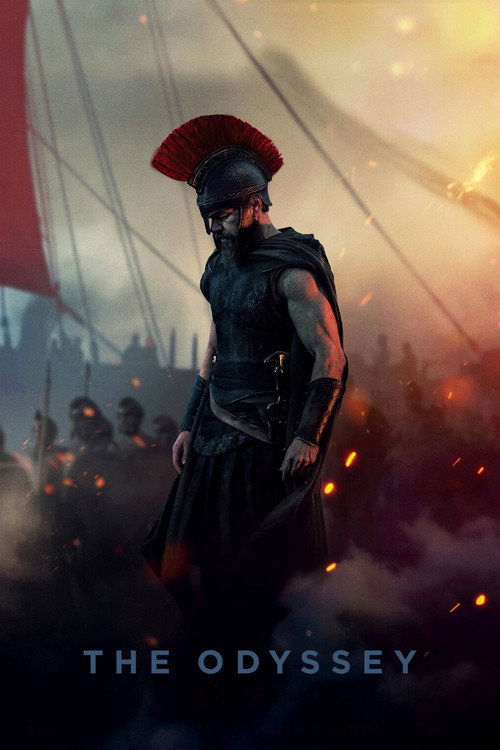
Christopher Nolan's adaptation of Homer follows Odysseus (Matt Damon), king of Ithaca, on his long voyage home from Troy, told in flashback on Calypso's island, and cuts between it and Ithaca, where his son Telemachus (Tom Holland) sets out to learn his fate while his wife Penelope (Anne Hathaway) holds off the suitors led by Antinous (Robert Pattinson). The familiar episodes are all here: the Cyclops, Circe, Hades, the Sirens, Scylla and Charybdis and the Sun God's cattle.
The most visible change is the casting. Helen and her twin Clytemnestra are played by a Black actress, Athena by a mixed-race actress and Odysseus's second-in-command Eurylochus by a brown-skinned actor and the soldier Sinon, a man in the myth, by Elliot Page, a trans man, and nothing in the story remarks on it. Two scenes give the women a modern edge: Circe tells Odysseus that his men are savages by nature, and Penelope tells her son that her twenty years of rule count for less than the bristles on his chin. The larger theme is the war itself. From the first flashback the siege of Troy is called a war of ambition and trade, and the story builds towards a reckoning with what the Greeks did there.
The most visible change is the casting. Helen and her twin Clytemnestra are played by a Black actress, Athena by a mixed-race actress and Odysseus's second-in-command Eurylochus by a brown-skinned actor and the soldier Sinon, a man in the myth, by Elliot Page, a trans man, and nothing in the story remarks on it. Two scenes give the women a modern edge: Circe tells Odysseus that his men are savages by nature, and Penelope tells her son that her twenty years of rule count for less than the bristles on his chin. The larger theme is the war itself. From the first flashback the siege of Troy is called a war of ambition and trade, and in the last act Odysseus, disguised as a beggar, confesses to Penelope that the night Troy fell broke the sacred law between peoples, and that the Greeks themselves are the 'people from the sea' whose raids are bringing their civilization down. He kills the suitors and leaves Ithaca for exile with Penelope.
What keeps the score mild is that none of this is held up as a lesson about the present. The recast characters are supporting parts, and none is flawless: Eurylochus leads a mutiny and the slaughter of the Sun God's cattle, and Helen goads her husband about his brother's fate. The two gender scenes are answered inside the film, and its women are not idealised either, from Calypso, who kept Odysseus drugged on lotus for seven years, to the murderous Clytemnestra. The anti-war theme is the film's own reading of Homer, framed as a tragedy of broken sacred law rather than as modern politics, and the values it upholds are hospitality, honouring the dead and loyalty.
Score breakdown
Each category is scored 0 to 3: 0 absent or presence only, 1 brief, 2 recurring or plot-relevant, 3 central or dominant. Timestamps refer to the film's running time.
| Category | Score | What we saw |
|---|---|---|
| Content | ||
| A Ethnicity | 0 | Ethnicity is never a theme, and no non-white character is held up as flawless: Eurylochus leads a mutiny and the raid on the Sun God's cattle, Helen taunts her husband and her twin is a murderer, and Athena scolds Odysseus as much as she guides him. Menelaus and Helen are a mixed couple in skin colour, seen together in one scene (1 for prominence), but as Spartan royals they share a culture, so one point comes off, giving 0. Her recasting is scored under E. |
| B Gender and feminism | 2 | Two scenes give the story a modern gender point. Circe is reworked from Homer's enchantress into a woman alone who expects the soldiers to assault her and tells Odysseus that turning his men into pigs only showed what they are. Penelope protests that her twenty years on the throne count for less than her son's beard. She also drives the climax and arms her husband, though Homer gives her the contest of the bow too.
|
| C Sexuality and gender identity | 0 | No gay, lesbian, bisexual or trans characters, and no sexuality theme. Sinon is not written as trans; Elliot Page's casting in the part is scored under E and K. |
| D Power and systems | 0 | The film is hard on the Trojan War and the Greeks who waged it, but as war, not as an institution oppressing an identity group or a colonised people. That is scored under J. |
| E Cultural and historical revision | 2 | Several established characters from Homer and Greek myth are played by non-white actors, which makes the cast more diverse than the Bronze Age Greeks of the source: Helen of Sparta and her twin Clytemnestra by a Black actress, the goddess Athena by a mixed-race actress, Odysseus's second-in-command Eurylochus by a brown-skinned actor of South Asian appearance, and Sinon, the Greek soldier left behind with the wooden horse and a man in the myth, by Elliot Page, an actor whose sex at birth differs from the character's. Scored 2, not 3: the changes run through recurring supporting parts, but Odysseus, Penelope, Telemachus and Antinous are not recast and nothing is made of the casting. The film's rewrites of Homer, Circe's motive and the meaning of Troy's fallthe Greeks as the 'people from the sea', carry the points scored under B and J.
|
| F Religion portrayal | 0 | Islam does not appear. The religion is the Greek gods, seen from the characters' side. |
| K Diverse cast | 2 | The leads are white: Odysseus, Penelope, Telemachus, Antinous, Menelaus, Calypso and Circe. The swineherd Eumaeus is played by a Latino actor, which does not count under the rubric. Beyond them recurring supporting parts go to non-white actors, Helen and Clytemnestra, Athena and Eurylochus, and the soldier Sinon to Elliot Page, an actor whose sex at birth differs from the character's, which a story set among Bronze Age Greeks does not account for. Scored 2: the recurring cast is mixed across ethnicity and gender identity. Not 3: the main cast is not mixed, no character's religion sets them apart, and nothing is made of it.
|
| Treatment | ||
| G Antagonist coding | 0 | The villains are Homer's: the suitors led by Antinous, mostly white men like the hero and his allies Telemachus and Menelaus, with one Black suitor among them. Penelope stands out on the good side, but against the source's own villains, and women fall on both sides of the moral line: Calypso drugs Odysseus and Clytemnestra kills her husband. The non-white characters are not set against white villains, and Circe's charge against Odysseus's men is counted under B. |
| H Didacticism | 1 | Two speeches state the gender point outright, each in one scene and in character. Odysseus's long confession late in the filmto Penelope is about war and is counted under J.
|
| I Message over story | 0 | The plot follows Homer's episodes. Circe's reworked motive is a one-scene change that the film also answers (see the counterweight), and the casting never touches the plot. |
| J Left-leaning politics framed as good | 2 | The war is the film's real subject. From the opening flashback Agamemnon's war is called an excuse to break Troy's hold on the trade routes, Helen sneers at Menelaus's 'righteous' victory, the crew plunder a village for supplies, and the story builds to Odysseus's confession about what the Greeks did at Troythat the sack of Troy broke the sacred law between peoples and that the Greeks themselves are the 'people from the sea' bringing their civilization down. Scored 2, not 3: the message is anti-war, not partisan, no political camp is mocked, and the values the film upholds are traditional ones (see notScored).
|
How the number is reached
- Categories A to K add up to 9 of 33, which gives 2.5 (9 ÷ 33 × 10, rounded to the nearest 0.5).
- Counterweight −0.5: The film complicates its own points: Odysseus answers Circe's charge by saying his men only want to go home, and she lets them go (1:18:39, 1:18:45), a crewman calls her a witch (1:19:52), the women are not idealised, and the recast characters are flawed: Eurylochus leads a mutiny (1:07:04) and Helen goads Menelaus about his brother (0:58:03).The film complicates its own points: Odysseus answers Circe's charge by saying his men only want to go home, and she lets them go (1:18:39, 1:18:45), and a crewman calls her a witch (1:19:52). The women are not idealised: Calypso admits she kept Odysseus on lotus for seven years (1:54:32), and Clytemnestra plotted her husband's murder (1:27:49). The recast characters are flawed: Eurylochus leads a mutiny (1:07:04) and the crew eat the forbidden cattle (1:48:45), and Helen goads Menelaus about his brother (0:58:03).
- Final rating 2.0, mild.
Considered, scored 0
- Menelaus and Helen as a couple (0:47:30, 0:48:30): different skin colour but a shared culture, seen in one scene, so 1 minus 1 gives 0 (A); her recasting is scored under E.
- Polybus, a suitor played by a Black actor (0:05:30, 1:36:30), who threatens the old dog Argus and then Telemachus (0:20:22, 0:20:48): a villain in a small part, so he adds nothing under E or K.
- Penelope's unravelled shroud (1:32:14) and her contest of the bow (2:30:51), both from Homer and shown without a point being made.
- Agamemnon's sacrifice of his daughter (0:14:27), from the myth.
- No same-sex or trans characters appear.
Evidence and confidence
Confidence: Medium. Full English subtitles from the embedded track. The villagers at the first landing speak only through an interpreter (0:29:43), so their own words are not given. Many night and interior scenes are very dark, so the ethnicity of a few minor characters, among them Agamemnon, could not be judged.
Category F definition: As in the rubric: Islam shown as a peaceful and tolerant religion, aligned with human rights, in a way that works as a corrective message.
Noted, not scored: The film's moral centre is traditional: hospitality as sacred 'Zeus' Law' (0:05:16, 0:13:11), honouring the dead (0:41:27, 1:26:01), a wife's fidelity (1:33:37) and a son's duty to lead (1:38:37). It treats civilization as precious and easily broken rather than oppressive (0:13:05, 2:26:42).
Rubric version 3. Reviewed 20 November 2026.