Woke rating
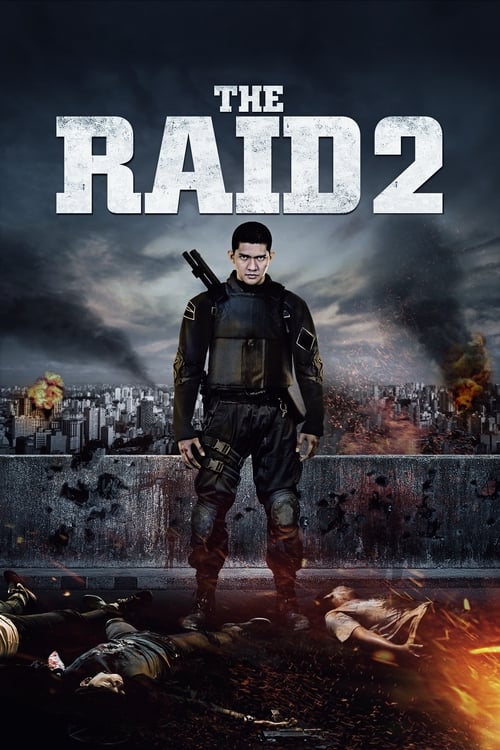
The Raid 2
None or negligible
A brutal Indonesian gangster epic about an undercover cop inside a crime family, with no progressive messaging: police corruption is its premise, told as a genre backdrop rather than an argument.
Gareth Evans's sequel picks up straight after The Raid. Rama (Iko Uwais), the rookie who survived the tower block, is recruited by a small anti-corruption unit and sent to prison under a false name, Yuda, to win the trust of Uco, the hot-headed son of crime boss Bangun, and expose the police on the gangs' payroll. The city is split between Bangun and the Japanese Goto family, and an upstart, Bejo, wants a piece of it. Most of the running time is set-piece fighting: a prison-yard brawl in the mud, a hammer-wielding assassin on a train, a car chase and a long duel in a restaurant kitchen.
There is next to nothing here for the rubric to find. Corruption is the premise: Rama's handler wants the police the gangs pay off, and Bejo tells Uco that politicians are cheap to buy. The film treats it as the rot of one city's underworld, with honest officers on the other side, not as a system that oppresses a group. Women appear as karaoke hostesses, Rama's wife on the phone, a hitman's estranged wife and one assassin, all without comment; the Japanese family is a business rival; and the villains are driven by ambition and inheritance.
There is next to nothing here for the rubric to find. Corruption is the premise: Rama's handler wants the police the gangs pay off, and Bejo tells Uco that politicians are cheap to buy. The film treats it as the rot of one city's underworld, with honest officers on the other side, not as a system that oppresses a group. Women appear as karaoke hostesses, Rama's wife on the phone, a hitman's estranged wife and one assassin, all without comment; the Japanese family is a business rival; and the villains are driven by ambition and inheritance: Uco, tired of his father's caution, joins Bejo's plan for a war with the Gotos and turns on Bangun, and the last act sends Rama through Bejo's restaurant to settle things.
The score stays at the floor because nothing is argued. The corruption plot is a crime-film engine, the gangsters have personal motives rather than group labels, and the story never bends toward a point.
Score breakdown
Each category is scored 0 to 3: 0 absent or presence only, 1 brief, 2 recurring or plot-relevant, 3 central or dominant. Timestamps refer to the film's running time.
| Category | Score | What we saw |
|---|---|---|
| Content | ||
| A Ethnicity | 0 | Ethnicity is never framed as an issue. The Japanese Goto family is a rival gang, and Uco's sneer about apologising to foreigners in their own language (1:44:50) is a villain's resentment. No mixed couple appears. |
| B Gender and feminism | 0 | Women are on the margins of a male underworld. Uco's abuse of karaoke hostesses (0:53:06 to 0:55:00) shows his cruelty, and the hammer-wielding assassin (1:32:30) is a killer like the others; neither is framed as a point about women. |
| C Sexuality and gender identity | 0 | No LGBTQ characters or themes. |
| D Power and systems | 0 | Police corruption is the premise of Rama's mission and comes back mid-film, but as the rot of a criminal underworld, not a system oppressing a group, and no political side is taken. Rama and his handler are honest officers. A genre backdrop (see zeroed). |
| E Cultural and historical revision | 0 | An original sequel with the same lead actor. No established characters or history are recast. |
| F Religion portrayal | 0 | Religion plays no part. |
| K Diverse cast | 0 | The cast is Indonesian, with the Japanese Goto family as the rival gang the plot turns on. That is the city's underworld as the story needs it; no character is gay and religion plays no part. |
| Treatment | ||
| G Antagonist coding | 0 | Heroes and villains alike are Indonesian men, with the Japanese Goto family as a rival gang, so nothing lines up along ethnicity or sex. The villains are gangsters driven by Uco's impatience to rise above his father (0:56:36, 1:45:02) and Bejo's ambition for territory (1:07:48). |
| H Didacticism | 0 | No speeches carry a social message. The handler's line that there is no clean war (0:09:05) is about tactics, and the gangsters' talk is about power and respect. |
| I Message over story | 0 | The story is a crime saga built around its fights, and none of its turns bends toward a message. |
| J Left-leaning politics framed as good | 0 | No political positions are argued. The film's cynicism about bribed police and politicians is not tied to any side. |
How the number is reached
- Categories A to K add up to 0 of 33, which gives 0.0 (0 ÷ 33 × 10, rounded to the nearest 0.5).
- No counterweight: None needed: nothing is scored, so there is nothing to complicate.
- Final rating 0.0, none or negligible.
Considered, scored 0
- Uco's humiliation of karaoke hostesses and his drunken rant that empty promises ruin the country (0:53:06 to 0:55:00, 0:54:42), shown as his cruelty, not as commentary.
- A hammer-wielding female assassin (1:30:30, 1:32:30), shown without comment on her sex.
- The rival Japanese Goto family (1:58:30), and Uco's sneer at apologising to foreigners in their own language on home soil (1:44:50), a villain's resentment rather than a message.
- Bejo's speech that Uco lives in his father's shadow while he made his own way (1:04:01, 1:04:17), personal ambition rather than a class argument.
- Prakoso's estranged wife keeping him from their son because of his bloody work (1:14:15 to 1:14:51), a private grief.
- Police corruption, the premise of Rama's mission (0:06:09, 0:10:44, 1:42:40), and Bejo's line that politicians are cheap to buy (1:09:27): the rot of a criminal underworld, with honest officers on the other side, not a political argument.
Evidence and confidence
Confidence: Medium. A transcript of the Indonesian audio (the file has no English text subtitles), translated as read. The long fight scenes have no dialogue, and the transcript filled them with repeated filler lines. A few passages, probably the Japanese dialogue of the rival Goto family, come out as garbled filler (around 0:32:50 to 0:34:30, 1:49:30 and 1:57:25 to 1:59:20). The surrounding Indonesian dialogue and the picture make the story clear.
Category F definition: As in the rubric: Islam shown as a peaceful and tolerant religion, aligned with human rights, in a way that works as a corrective message.
Rubric version 3. Reviewed 18 November 2026.