Woke rating
The Rivals of Amziah King
None or negligible
A slow-burning Oklahoma crime drama about a beekeeper's foster daughter and a honey business under attack, with a streak of small-versus-big populism and a few jokes about ethnicity, but no progressive message.
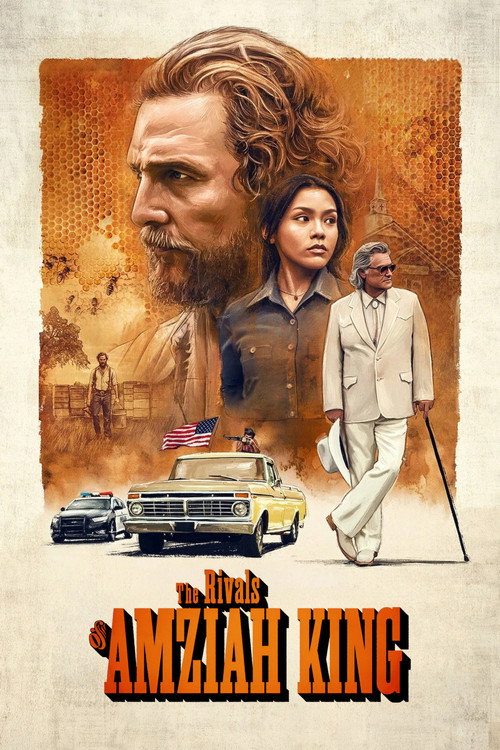
Andrew Patterson's crime drama follows Amziah King (Matthew McConaughey), a born-again beekeeper and bluegrass player in rural Oklahoma who runs a small honey plant with a crew of misfits. After a chance meeting he reconnects with Kateri, a young Native woman who lived with him and his late wife as a foster child, and draws her into the business. The first half is loose, comic and musical; the second turns into a revenge thriller when the business is hit and Kateri sets out to find the rivals behind it.
Andrew Patterson's crime drama follows Amziah King (Matthew McConaughey), a born-again beekeeper and bluegrass player in rural Oklahoma who runs a small honey plant with a crew of misfits. After a chance meeting he reconnects with Kateri, a young Native woman who lived with him and his late wife as a foster child, and draws her into the business. The first half is loose, comic and musical; the second turns into a revenge thriller after Amziah dies of a heart attack, his hives are stolen and Kateri, who inherits the plant and its debts, sets out to find the thieves and the big operator behind them.
What little the rubric picks up is incidental. Kateri's Native background and Amziah's Brazilian tenants come up only as jokes about saying the wrong thing (0:36:15, 1:24:05). The last act's rival is a big agribusiness operator who has ruined small farmers and is shielded by local judges with stakes in his businesses (1:38:32, 1:40:02), which gives the film a note of small-versus-big populism, but it is told as one man's crimes and tied to no group or cause. Kateri's mother, a farm worker, is said to have died in a cell after crossing the police (1:02:18), a single line that is never followed up.
Nothing is argued. There are no speeches, the police are decent and on the small farmers' side, and the film's world is a warm picture of rural Christian community, with hymns, potlucks and prayers for the sick. The rival is also given a human side, and the heroine's own methods are anything but cleanMcCoy is given a gentle scene about his old dog and his sick wife, and the film implies that Kateri herself kills twice to get her way: the thief in his own hot room, and McCoy's wife with ricin from his own crop.
Score breakdown
Each category is scored 0 to 3: 0 absent or presence only, 1 brief, 2 recurring or plot-relevant, 3 central or dominant. Timestamps refer to the film's running time.
| Category | Score | What we saw |
|---|---|---|
| Content | ||
| A Ethnicity | 1 | Ethnicity comes up only as a few jokes about saying the wrong thing: Kateri questions Amziah for naming his tenants' nationality, and Remick fumbles over her being Native. No point is made about racism, and no mixed couple appears. Kateri, the Native heroine, is far from flawlessno clean avenger: the film implies she kills twice, and Rippy, Amziah's Black lawyer and friend, is a decent supporting part rather than a model, so neither counts.
|
| B Gender and feminism | 0 | Kateri carries the second half, and Amziah's talk about the queen bee as the strongest survivor (0:33:17) returns at the end (2:02:58), but it is bee lore and character, not a point about women or men. |
| C Sexuality and gender identity | 0 | No LGBTQ+ characters or themes. The nearest are crude jokes about a girlfriend's haircut (0:09:38) and a strip club (1:23:27). |
| D Power and systems | 0 | The last act's rival is a big agribusiness operator who ruins small farmers and is protected by local judges tied to his businesses, and one line hints at police abuse in Kateri's past. None of it is framed as oppression of a group: it is told as one man's crimes, the police are decent and one officer has tried for years to bring him down (see zeroed). |
| E Cultural and historical revision | 0 | An original story. No established characters or history are recast. |
| F Religion portrayal | 0 | Islam does not feature. Religion appears only as rural Christianity: hymns, a gospel song and a born-again hero. |
| K Diverse cast | 0 | The cast is the rural Oklahoma it is set in: mostly white small-town people, a Native foster daughter in a state with a large Native population, Rippy, a Black lawyer in town, and Amziah's Brazilian tenants, who do not count as non-white under the rubric. Religion appears only as rural Christianity, with one non-believer in the crew, and there are no gay characters, so the mix does not go beyond what the place would have. |
| Treatment | ||
| G Antagonist coding | 0 | The main rival is a wealthy white agribusiness owner, and the heroine of the second half is a young Native woman, but the sides do not divide along ethnicity or sex. The good side of the first half is Amziah and his mostly white crew, the police are decent, the thief's crew are foreigners, McCoy is given a gentle, human scene, and Kateri's own methods are anything but cleandeadly. What defines McCoy is wealth and reach, which is class, not a demographic group. |
| H Didacticism | 0 | No speeches state a social message. The farmers' accounts of McCoy and Oat's rundown of how he stays out of court (1:40:18) are plot exposition, and Amziah's talks about the hive (0:31:12) are about community and patience, not politics. |
| I Message over story | 0 | The story leads throughout: a loose character piece that turns into a theft-and-revenge thriller, with nothing bent toward a message. |
| J Left-leaning politics framed as good | 0 | No left-leaning politics are argued. The villain is a monopolising big operator, but the film's sympathies lie with small business, faith, inheritance and self-reliance, and no party or cause is named. |
How the number is reached
- Categories A to K add up to 1 of 33, which gives 0.5 (1 ÷ 33 × 10, rounded to the nearest 0.5).
- Counterweight −0.5: The film complicates the little it says: its jokes about ethnicity land on the characters who fumble them (1:24:10), and its Native heroine's own methods are far from clean.The film complicates the little it says: its jokes about ethnicity land on the characters who fumble them (1:24:10), and the Native foster daughter at the centre is no clean avenger: she lies to the police about migrant workers (1:34:28), and the film implies she leaves the thief to die in his hot room (1:17:54, 1:34:37) and plants the meal that kills McCoy's sick wife with ricin from his own crop (1:52:02, 1:59:00).
- Final rating 0.0, none or negligible.
Considered, scored 0
- A mixed cast shown without comment, including Kateri as a Native woman in Oklahoma, Rippy, Amziah's Black lawyer and friend (0:06:11), and the Brazilian couple who live behind his house (0:36:40): the mix of the real setting (K), and none of them held up as flawless (A).
- Kateri as a capable young woman who takes over the honey plant, and the queen-bee talk that frames her (0:33:17, 2:02:58): bee lore and character.
- Amziah giving work to men with prison records (1:29:43) and Remick's story of combat, drugs and jail (1:28:51): backstory, not a point about the justice system.
- Chimmy as a non-believer who still eats the Christians' food (0:30:08), a joke.
- Amziah's potluck gossip about a polygamous country sect whose women he would like to set free (0:28:33), a tall tale rather than a point about women or religion.
- Pesticide that stirs up a swarm at a school (0:44:09) and a dealer shut down for selling bees with mites and pesticides (1:13:02): beekeeping detail, not an environmental message.
- The thief's crew of foreigners (1:09:01) and the migrant workers Kateri names to the police (1:34:28), mentioned without comment.
- The big agribusiness rival who ruins small farmers and is shielded by local judges (1:13:30, 1:38:32, 1:40:02), and the line about Kateri's mother dying in a cell after crossing the police (1:02:18): one man's crimes and an unexplored line, tied to no group or political cause.
Evidence and confidence
Confidence: Medium. Full English subtitles from the embedded track. Several stretches have no dialogue (for example 1:13:54 to 1:17:54, 1:43:30 to 1:46:01 and 2:03:17 to 2:06:35), and some key turns are told only in pictures, so they were read from the picture and the dialogue that follows.
Category F definition: As in the rubric: Islam shown as a peaceful and tolerant religion, aligned with human rights, in a way that works as a corrective message.
Noted, not scored: The film's rural Christian world is drawn warmly: Amziah calls himself a born-again Christian (0:14:30), the band plays a gospel song about the one crucified (0:41:17), the funeral closes with 'It Is Well with My Soul' (1:00:22), and neighbours send prayers and cards to the sick (1:52:45). The humour is unfiltered and un-PC, from a Deliverance gag about an inbred banjo player (0:10:11) to Amziah's riff on a child with a grown man's face (0:27:30).
Rubric version 3. Reviewed 18 November 2026.