Woke rating
Upon Entry
None or negligible
A tense border-interrogation thriller whose picture of US immigration control as invasive and humiliating gives it a slight progressive slant, though it shows rather than argues and does not make its couple simple victims.
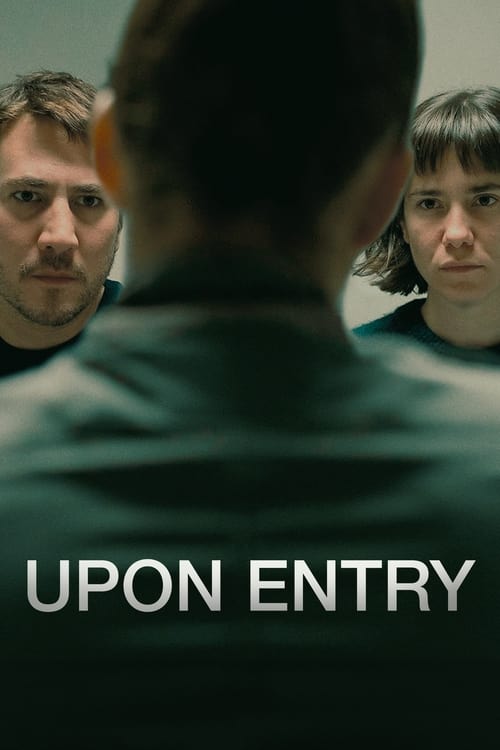
Alejandro Rojas and Juan Sebastián Vásquez's thriller follows Diego (Alberto Ammann), a Venezuelan urban planner, and his Catalan partner Elena (Bruna Cusí), a dancer, who fly from Barcelona to Newark with immigrant visas from Elena's green-card lottery win. Instead of making their connection to Miami, they are sent to secondary inspection, and almost the whole film takes place in a waiting room and an interview office as two officers question them about their relationship, money, plans and pasts.
The US border process is the film's subject. A radio host in their Barcelona taxi mocks Trump's border wall in the opening minute, and at Newark the couple are refused food, water and phones, searched, made to unlock their devices, asked how often they have sex, threatened with jail and deportation, and pressed to dance on demand. Ethnicity comes up in a few exchanges: an officer's crack that Diego likes to mix nationalities, Elena's mother's early dislike of his Latin American origin, which an officer calls racist, and Elena's protest at being questioned for dating someone from a troubled country. The questioning also turns up something Diego had not told Elena.
The US border process is the film's subject. A radio host in their Barcelona taxi mocks Trump's border wall in the opening minute, and at Newark the couple are refused food, water and phones, searched, made to unlock their devices, asked how often they have sex, threatened with jail and deportation, and pressed to dance on demand. Ethnicity comes up in a few exchanges: an officer's crack that Diego likes to mix nationalities, Elena's mother's early dislike of his Latin American origin, which an officer calls racist, and Elena's protest at being questioned for dating someone from a troubled country. The questioning turns up an engagement to an American woman and an approved fiancé visa that Diego never mentioned to Elena, and an officer offers to let Elena in without him. In the end both are admitted with a curt welcome, after their devices have been copied.
The score stays low because the film shows its case rather than arguing it. No one makes a speech about immigration policy, and the officers are not coded by ethnicity or politics: the one who questions Diego in Spanish has a cousin who married an American for a green card, and she calls Diego a snob for looking down on people who cross the border. The questioning finds real cracks in the couple's storya real lie, since Diego told the officers Elena knew about his engagement when she did not, Elena refuses to call her mother racist, and the film leaves open how far Diego is in it for the paperswas with Elena for the papers.
Score breakdown
Each category is scored 0 to 3: 0 absent or presence only, 1 brief, 2 recurring or plot-relevant, 3 central or dominant. Timestamps refer to the film's running time.
| Category | Score | What we saw |
|---|---|---|
| Content | ||
| A Ethnicity | 1 | Diego's nationality drives the officers' suspicion, and prejudice against Latin Americans is raised in a few exchanges, once when an officer calls Elena's mother racist. Scored 1, not 2: each exchange is brief, and Elena rejects the label. The couple themselves do not count as mixed: Diego is Venezuelan and Elena Catalan, both appear white, share a language and a secular outlook and live together in Barcelona, a common match in Spain, and the film makes his origin part of the plot.
|
| B Gender and feminism | 0 | Elena is the lottery winner and Diego her dependant, but the film makes no point about gender of it. The question whether she is pregnant (0:39:41) and the demand that she dance (1:03:06) are part of the pressure the officers put on both partners, not a framing of women as victims. |
| C Sexuality and gender identity | 0 | No LGBTQ characters or themes. The couple's unmarried civil union, their lack of religion and the questions about their sex life are part of the interrogation, and nobody argues a case about sexuality or marriage. |
| D Power and systems | 0 | The film's picture of US secondary inspection as invasive, arbitrary and humiliating is immigration politics without an identity angle: the officers' suspicion is about whether the relationship is genuine and falls on both partners, and the few remarks about Diego's origin are scored under A. It is counted under J. |
| E Cultural and historical revision | 0 | An original story. No established characters or history are recast. |
| F Religion portrayal | 0 | Islam is not portrayed. The couple say they respect all religions (0:34:26), and a traveller called Mr. Bachir is questioned about his luggage (0:14:53), without comment. |
| K Diverse cast | 0 | The cast is four people with real parts: Diego and Elena, who both appear white, and the two officers, a white man and a Latina woman. That is the people a Newark immigration office and a Spanish couple would really bring together, the mixed travellers in the waiting room are extras, nobody is gay, and religion comes up only as the couple's lack of it. |
| Treatment | ||
| G Antagonist coding | 0 | The antagonists are the two officers, a white man and a Latina woman, defined by their role rather than by ethnicity, sex or politics (the one who questions Diego in Spanish comes from an immigrant family), and their suspicion has some basisDiego's lie shows their suspicion had a basis. The moral sides do not divide along ethnicity or sex, and the officers' part in the film's picture of border control is counted under J. |
| H Didacticism | 1 | No speeches. The one line that states a message under A to F directly is Elena's protest at being questioned for her choice of partner. The radio's sarcasm about the wall is counted under J.
|
| I Message over story | 0 | The story leads. The interrogation is the plot, and each question feeds the drama of whether the couple's relationship is real. The demand that Elena dance (1:03:06) is the one moment that strains belief, but it serves that drama rather than a separate point. |
| J Left-leaning politics framed as good | 2 | The US border process is the film's subject and is drawn as invasive, arbitrary and humiliating, with the film's sympathy on the travellers' side, and the opening radio segment mocks Trump's plan for a border wall, placing the film in that political moment. Scored 2, not 3: it is shown rather than argued, no one speaks against the system as such, no party or policy is named after the opening, the officers are not drawn as political, and the questioning finds real cracks in the couple's storyexposes a lie Diego told.
|
How the number is reached
- Categories A to K add up to 4 of 33, which gives 1.0 (4 ÷ 33 × 10, rounded to the nearest 0.5).
- Counterweight −0.5: the film complicates its own sympathies: the questioning finds real cracks in the couple's story (1:01:20), Elena admits the move was Diego's idea (1:05:34), she rejects the officer's word 'racist' for her mother (0:59:19), the officer who questions Diego comes from an immigrant family and calls him a snob for looking down on those who cross the border (0:50:53, 0:51:55), and Diego says Venezuela's police are nothing like America's (0:47:22).the film complicates its own sympathies: Diego hid his engagement to an American woman and an approved fiancé visa from Elena (0:36:31, 1:01:20) and lied to the officers that she knew (0:50:03, 1:09:45); Elena admits the lottery application was his idea and that she had never thought of the US before meeting him (1:05:34, 1:05:48); she rejects the officer's word 'racist' for her mother (0:59:19); the officer who questions Diego comes from an immigrant family and calls him a snob for looking down on those who cross the border (0:50:53, 0:51:55); and Diego says Venezuela's police are nothing like America's (0:47:22).
- Final rating 0.5, none or negligible.
Considered, scored 0
- Diego and Elena are a Venezuelan and Catalan couple who both appear white on screen and share a language and a secular life in Barcelona (0:28:59, 0:34:21); a Latin American partner does not by itself make a couple mixed, the match is common in Spain, and the remarks about his origin are scored under A.
- The mixed group of travellers in the waiting room (0:15:30, 1:06:30) and Mr. Bachir questioned about his luggage (0:14:53), extras shown without comment, and the two officers, a white man and a Latina woman (0:46:30, 0:56:30), the staff such an office would have (K).
- Elena as the lottery winner and Diego as her dependant (0:28:13), not made into a point about gender.
- The couple's unmarried civil union and lack of religion (0:28:59, 0:34:21), and the officer's suggestion that marriage is old-fashioned (0:36:03), part of the questioning rather than advocacy.
- Elena's diabetes (0:21:03, 0:53:27), shown without comment.
Evidence and confidence
Confidence: Medium. Full English subtitles from the embedded track, which also translates the Spanish and Catalan dialogue, checked against the forced track. The story ends at about 1:12:30, followed by credits. Only a few stretches are wordless (0:41:41 to 0:43:04, 1:06:08 to 1:07:21, 1:10:21 to 1:11:58).
Category F definition: As in the rubric: Islam shown as a peaceful and tolerant religion, aligned with human rights, in a way that works as a corrective message.
Noted, not scored: Diego describes Venezuela as a violent country where people are jailed, shot or disappear and the political situation does not help, and says he was kidnapped by men who claimed to be police (0:47:01, 0:47:28). The country's government is never named.
Rubric version 3. Reviewed 18 November 2026.