Woke rating
Wasteman
None or negligible
A tense British prison drama about a cellmate bond that turns dangerous; an overcrowded, understaffed jail is the backdrop, but there is no identity or political messaging.
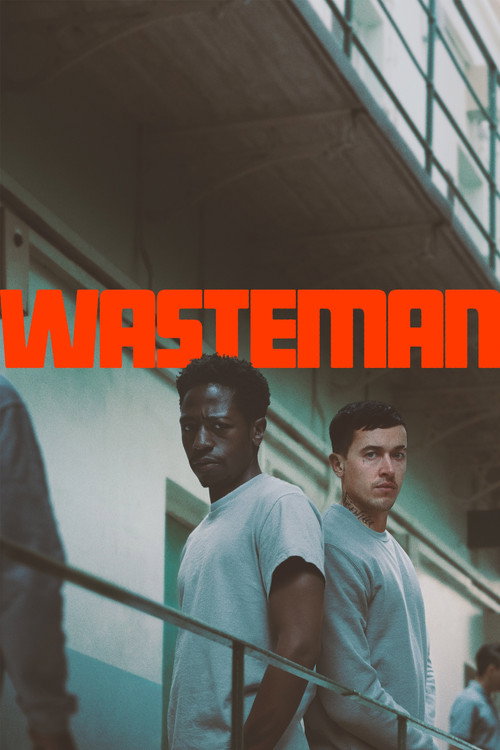
Cal McMau's prison drama follows Taylor (David Jonsson), thirteen years into a sentence after pills he sold at a rave killed two young men. A scheme to ease overcrowding offers him early parole if he stays out of trouble, just as a volatile new cellmate, Dee (Tom Blyth), moves in, starts dealing from the cell and helps Taylor get back in touch with the 14-year-old son he has not seen in years. The bond pulls Taylor into the wing's drug feuds and puts his release at risk.
The nearest the film comes to a message is the state of the prison. Taylor's early release comes from a nationwide review of sentences to take pressure off the service (0:07:23), an officer says they are three staff down (0:10:25), a TV bulletin mentions overcrowding (0:28:02), Dee boasts that the staff cannot search a cell (0:24:59), and after a brawl the wing is locked down until there are enough staff to keep it safe (0:55:55). The film shows this as the texture of the place, not as an argument, and no one blames the system for what the inmates do.
What keeps the score at zero is that the drama is personal. Taylor owns his crime and says he understands why his son's mother thinks badly of him (0:31:38), the staff are stretched but decent, and the violence comes from individual prisoners' greed, debts and grudges. The one point that counts is that the antagonist, Dee, is white and the hero Black, but Dee is given his reasons, the white officers are decent and Taylor carries real guilt. Ethnicity is never raised, the wing is mixed as a British prison is, and no couple of any kind is shown on screen.
Score breakdown
Each category is scored 0 to 3: 0 absent or presence only, 1 brief, 2 recurring or plot-relevant, 3 central or dominant. Timestamps refer to the film's running time.
| Category | Score | What we saw |
|---|---|---|
| Content | ||
| A Ethnicity | 0 | No ethnic message. Taylor is Black, Dee is white and the wing is mixed, but ethnicity is never mentioned, and Taylor is no blameless victim: he is serving time for pills that killed two young men. An England flag on the wall of a rival crew's cell (1:11:30, 1:14:30) is set dressing. No couple is shown: Taylor's ex-partner and son are only heard on the phone. |
| B Gender and feminism | 0 | No gender point. Taylor's ex keeps their son away from him, and the film presents her reasons as fair (0:16:45). The prison is all-male, and the sexual taunts are bullying. |
| C Sexuality and gender identity | 0 | Dee's taunt about oral sex (0:15:00) and the pin-ups on the cell walls are prison machismo with no message. |
| D Power and systems | 0 | The prison is shown as overcrowded, understaffed and awash with drugs, and Taylor's parole comes from a scheme to relieve the pressure (0:07:23, 0:28:02, 0:55:55). Not scored: it is a backdrop, never argued and not framed as a system oppressing a group, and the officers are stretched rather than cruel. With no side taken, it scores nothing under J either. |
| E Cultural and historical revision | 0 | An original story. No established characters or history are recast. |
| F Religion portrayal | 0 | Islam does not feature. |
| K Diverse cast | 0 | The leads are a Black and a white cellmate on a mixed wing, with mostly white officers, the mix a British men's prison would have. No character is gay and religion plays no part. |
| Treatment | ||
| G Antagonist coding | 1 | The antagonist is Dee, a white cellmate who deals from the cell, scorns the staff and turns on Taylorthreatens Taylor's son to force him into an attack, set against Taylor, the Black hero. Scored 1, not more: the officers, who are white, are stretched but decent, the rival crew are drawn with some warmth (the man whose hair Taylor cuts talks about his baby son and wishes him luck, 1:11:47, 1:14:55), rivals put a price on Dee's own head (0:56:32), and Dee is given his reasons, 'what else have I got?' (1:02:58).
|
| H Didacticism | 0 | No speeches. The parole questionnaire, the rehab leaflet (0:51:56) and the lockdown announcement are procedure, not lectures. |
| I Message over story | 0 | The story leads. The prison's crowding sets up Taylor's parole, but nothing bends to make a point. |
| J Left-leaning politics framed as good | 0 | No political side. The early-release scheme and the overcrowding are facts of the setting, with no party or policy blamed; the TV bulletin says only that ministers are debating a controversial measure (0:28:02). |
How the number is reached
- Categories A to K add up to 1 of 33, which gives 0.5 (1 ÷ 33 × 10, rounded to the nearest 0.5).
- Counterweight −0.5: The film complicates the one point that scores: Dee is given his reasons and a real bond with Taylor, explaining his hold over him with 'what else have I got?' (1:02:58), the white officers are overstretched but decent, one warning Taylor not to throw away his release (0:42:46) and another wishing him well on his last day (1:16:44), and Taylor owns the deaths his pills caused (0:31:38).
- Final rating 0.0, none or negligible.
Considered, scored 0
- Taylor and Dee, a Black and a white cellmate, and an ethnically mixed wing, the mix a British prison would have (K).
- An England flag on the wall of a rival crew's cell (1:11:30, 1:14:30), set dressing with no comment.
- Becca's refusal to let Taylor see their son (0:16:21), presented as understandable rather than as a point about mothers or fathers.
- Dee's sexual taunt at Taylor (0:15:00), prison bullying.
- The demolition of Taylor's old estate (0:14:03, 0:16:26), a detail of loss rather than a point about housing.
- Subutex prescribed inside (0:18:06) and a rehab place offered on release (0:51:56), part of the setting.
- No couple of any kind is shown on screen.
Evidence and confidence
Confidence: Medium. Full English subtitles from the file's embedded track. Long stretches have no dialogue (for example 1:20:35 to 1:23:17).
Category F definition: As in the rubric: Islam shown as a peaceful and tolerant religion, aligned with human rights, in a way that works as a corrective message.
Rubric version 3. Reviewed 18 November 2026.