Woke rating
Breeders
None or negligible
A foul-mouthed parenting comedy with almost no politics, whose few points come from two mixed couples in the wider family and a late coming-out episode played as family drama rather than a cause.
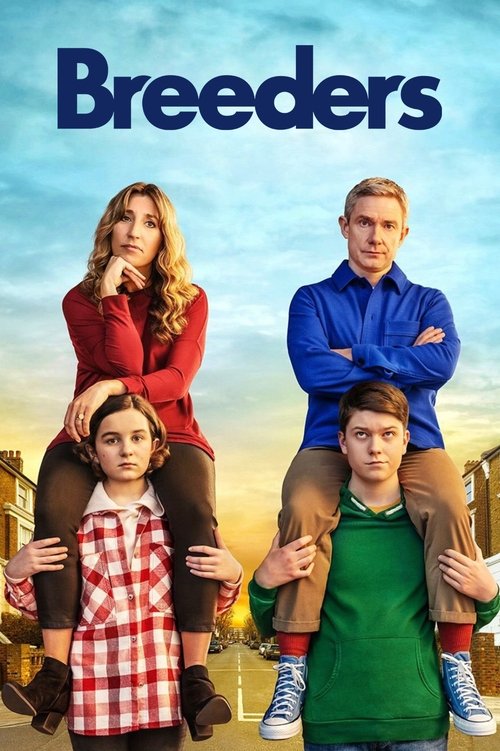
Breeders, created by Simon Blackwell, Chris Addison and Martin Freeman, follows Paul (Freeman) and Ally (Daisy Haggard), a London couple whose love for their children Luke and Ava is matched by exhaustion and, in Paul's case, rage. The first season deals with small children; from season 2 the children are teenagers, and the stories turn to anxiety, school, friendships and first relationships, alongside Paul's parents Jim and Jackie and Ally's mother Leah. The sample is two episodes from each of the four seasons.
The messaging that does register is light and late. In season 4 Ava comes out and invites her girlfriend Holly to meet the family; when Holly backs out, Ava tells her parents she wanted it to be a big deal, an affirmation, and they promise to love her whoever she is. The romance continues later in the season. Leah's neighbour Alex, who is Black, becomes her partner from season 2 on, and season 4 brings a South Asian family into the fold. The show never comments on ethnicity, and as the partners are Londoners of the same culture these couples count for little.
The messaging that does register is light and late. In season 4 Ava comes out and invites her girlfriend Holly to meet the family; when Holly backs out, Ava tells her parents she wanted it to be a big deal, an affirmation, and they promise to love her whoever she is. In the season's last episode she tells her best friend Grace that she loves her. Leah marries her neighbour Alex, who is Black, between seasons 2 and 3, and in season 4 Luke has a baby with Maya, whose family is South Asian. The show never comments on ethnicity, and as the partners are Londoners of the same culture these couples count for little.
What keeps the score low is that Breeders is about parenting, not politics. Its subjects are sleepless nights, Paul's temper, Luke's anxiety and panic attacks, a schoolgirl feud and ageing grandparentsJim and Jackie's separation and Jackie's failing memory, and its jokes are profane and often politically incorrect, from Leah's barbs to Jim's grumbling about 'university' types. Nobody is cast as a villain, no political side is taken, the few non-white characters are what a south London setting would have, and Ava's Christian faith is treated warmly. Even the coming-out episode is mostly about a younger sister who feels overshadowed by her brother's chaos. Eight of forty episodes is a thin sample, and the others could differ.
Score breakdown
Each category is scored 0 to 3: 0 absent or presence only, 1 brief, 2 recurring or plot-relevant, 3 central or dominant. Timestamps refer to the film's running time.
| Category | Score | What we saw |
|---|---|---|
| Content | ||
| A Ethnicity | 1 | No one mentions ethnicity; the point comes from two couples in the wider family. Leah's neighbour Alex, who is Black, becomes her partnerhusband and recurs across seasons 2 and 3, and season 4 adds a South Asian family through a new relationshipLuke's partner Maya, mother of his son, comes from a South Asian family. Each is a recurring supporting couple (2), less 1 because the partners are Londoners of the same culture who differ only in skin colour, so each scores 1. Alex is a kindly minor character whose relentless niceness is a running joke at Leah's expense, not a flawless portrayal held up as a model.
|
| B Gender and feminism | 0 | No gender message. Old-fashioned roles come up only as generational comedy (see zeroed), and the show's hands-on modern father is defined by his rage at his children rather than held up as a model. |
| C Sexuality and gender identity | 1 | Ava comes out in season 4 and one episode is built around it: her parents resolve not to fumble it, and when her girlfriend backs out of meeting them, Ava says she wants it to be a big deal and an affirmation, and they promise to love her whoever she is. Scored 1: the message sits in that one scene, the episode shares it with a farce about Luke's drunk friend, and elsewhere her romance and her declaration of love to Grace is shown as ordinary teenage romance. Ava is an ordinary teenager with her own jealousies of her brother, not a flawless model, and no one objects.
|
| D Power and systems | 0 | No institution is cast as an oppressor. The housing association that makes Jim and Jackie downsize gets one angry rant, which Jackie answers by calling it fair (S02E08 0:04:40), and Ally's objection to cocaine is a moral point, not about a group (see zeroed). |
| E Cultural and historical revision | 0 | An original sitcom. No established characters, history or source material are recast. |
| F Religion portrayal | 0 | Islam does not come up. |
| K Diverse cast | 0 | The Worsleys and the grandparents are white British. The supporting cast adds Alex, who is Black, Maya's South Asian family in season 4, and Ava's coming out, but a south London setting accounts for that ethnic mix, Ava is a single gay character, and religion is not mixed: Ava's Christian faith is her own. Nothing goes beyond what the place would really have. |
| Treatment | ||
| G Antagonist coding | 0 | There are no villains. The obstacles are tiredness, children, illness and the characters' own tempers; the nearest things to antagonists, a manipulative schoolgirl in S02E08 and Luke's drunk friend in S04E04, are individual nuisances, not types. |
| H Didacticism | 1 | One scene states the point outright: Ava's speech about wanting her coming-out to matter and her parents' promise of unconditional love. Elsewhere no one lectures.
|
| I Message over story | 0 | The story leads. The coming-out shares its episode with a farce about Luke bringing a drunk friend home, and the plot turns on that clash and on sibling rivalry, not on a message. |
| J Left-leaning politics framed as good | 0 | No political side is taken. The only political grumble is Jim's against the housing association and 'university' types (noted below). |
How the number is reached
- Categories A to K add up to 3 of 33, which gives 1.0 (3 ÷ 33 × 10, rounded to the nearest 0.5).
- No counterweight: None applies. The coming-out is played with some irony, as Holly thinks big coming-outs are passé (S04E04 0:16:52) and the parents fumble the moment, but the episode ends by affirming Ava's wish for it to matter (0:22:24), and the rest of the sample has no messaging to complicate.
- Final rating 1.0, none or negligible.
Considered, scored 0
- Ava's late romance, from the trip to Brighton with Holly (S04E10 0:11:51) to her declaration of love to a friendGrace (0:22:45), shown as ordinary teenage romance (C).
- Alex's niceness, which Leah complains makes her feel married to Jesus (S03E03 0:03:33): a running joke, not a flawless portrayal (A).
- The non-white characters in the wider cast, such as Alex (S02E02 0:10:30) and Maya's family (S04E10 0:16:30): the mix a south London setting would have (K).
- Mixed casts shown without comment, such as the two bin men who come to talk to Paul about his empty bottles in S01E01 (0:16:14).
- Grace's ADHD, dyspraxia and anxiety diagnoses (S02E02 0:07:04) and Luke's anxiety disorder (0:19:43): the parents' argument over labels is about parenting, not identity.
- Generational gender-role comedy: Jim admits Jackie did all the housework (S01E01 0:09:46) and learns to cook only late in life (S04E10 0:06:05), and Leah jokes that men like a 'little woman in the kitchen' (S03E09 0:07:54).
- Ava's first period (S03E03 0:08:24, 0:13:14), handled as family embarrassment.
- Jokes about the young neighbour Isaac's eyelashes (S02E08 0:14:37, 0:25:10) and Darren calling Luke handsome (S03E09 0:07:29).
- Leah's complaint that her builders speak no English, which she insists is 'not a racist complaint' (S01E01 0:05:56), a joke at her expense.
- Ally's objection to cocaine as a trade that gets teenagers stabbed so the middle classes can party (S02E08 0:20:14), a moral point not tied to any group's oppression.
Evidence and confidence
Confidence: Medium. Full English subtitles from the embedded track for eight episodes, two from each season (8 of the 40 episodes the owner has). S04E04 has no subtitles from 0:06:01 to 0:11:33 and the picture is the same at 0:07:30 and 0:10:30, so about five and a half minutes of that episode look damaged and were not reviewed. Maya, who appears in season 4, is not clearly seen, so her family's background is judged from the guests at the S04E10 party and her son's surname.
Category F definition: As in the rubric: Islam shown as a peaceful and tolerant religion, aligned with human rights, in a way that works as a corrective message.
Noted, not scored: Jim rails at the housing association that makes him and Jackie downsize, blaming 'university' types who think people like them are worthless (S02E08 0:04:44). Ava's Christian faith is treated warmly: the vicar Susie owns up to overstepping and comes across as a sympathetic friend (S03E03 0:21:40), and Jackie tells an unhappy Ava that Jesus loves her (S03E09 0:10:14).
Episodes reviewed: S01E01, S01E07, S02E02, S02E08, S03E03, S03E09, S04E04, S04E10.
Rubric version 3. Reviewed 18 November 2026.