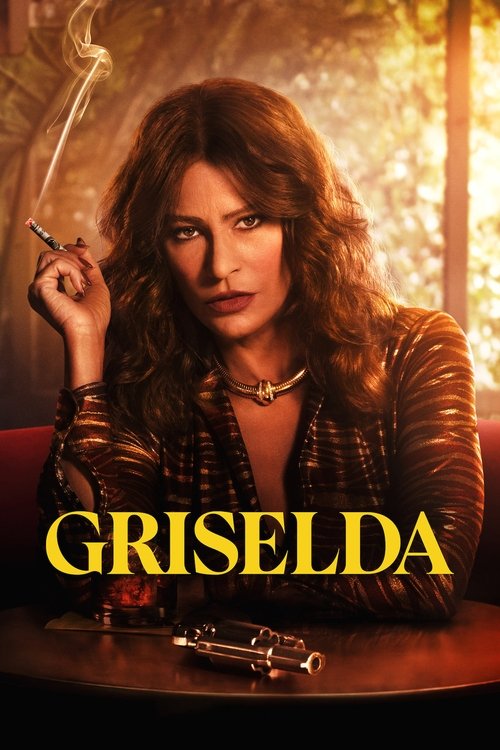
Woke rating
Griselda
Mild
Netflix's limited series about the Miami cocaine boss Griselda Blanco makes a woman's fight against the men who dismiss her its constant theme, but it never makes her a heroine and lets the cost of her rise count against her.
The six-episode series follows Griselda Blanco (Sofía Vergara) from her flight from Medellín to Miami with her three sons in the late 1970s to her rise as the city's cocaine 'Godmother'. A second strand follows June Hawkins, a Miami police analyst who is the first to suspect that a woman is behind the killings. Much of the dialogue is in Spanish.
Gender is the theme of nearly every episode. Griselda's husband uses her to pay off a debt, dealers tell her to go back to being a housewife, a rival refuses to take orders from a woman, and the cartel's men admit they only listen to men. June's storyline mirrors it: a boorish detective tells her that her job is to translate and keep the coffee hot, her captain is sure no woman makes deals, and she keeps being proven right. A few scenes touch on ethnicity, from a detective's 'brown wave of crime' to Griselda's speech telling Cuban Marielitos that people see only their tattoos. That speech is the series' most direct statement of grievance.
Gender is the theme of nearly every episode. Griselda's husband makes her sleep with his brother to pay off a debt, and she shoots him. Dealers tell her to go back to being a housewife, a rival refuses to take orders from a woman, Amilcar fronts her plan because the others only listen to a man, and the cartel's Rafa cuts her out because a smart woman scares him more than idiots he can control. June's storyline mirrors it: a boorish detective tells her that her job is to translate and keep the coffee hot, her captain is sure no woman makes deals, and she keeps being proven right until Griselda is in her custody. A few scenes touch on ethnicity, from a detective's 'brown wave of crime' to Griselda's speech telling Cuban Marielitos that people see only their tattoos. That speech is the series' most direct statement of grievance.
What keeps the rating mild is that the series does not take Griselda's side. Her grievance is real, but it becomes her excuse: she uses it to recruit gunmen, her rise costs innocent livesshe has a witness's wife killed and her paranoia gets a two-year-old shot, and when her friend Carmen says that fighting the monster turns you into it, Griselda finishes the sentence herself. June says the police have built a woman they were too impressed by into a criminal genius. The men are not all villains, June's partners are decent, and Griselda's rivals act from business motives. There is no LGBTQ messaging, little politics beyond period colour, and the largely Latin American cast is the world the story is set in.
Score breakdown
Each category is scored 0 to 3: 0 absent or presence only, 1 brief, 2 recurring or plot-relevant, 3 central or dominant. Timestamps refer to the film's running time.
| Category | Score | What we saw |
|---|---|---|
| Content | ||
| A Ethnicity | 1 | Ethnicity comes up in a few scenes: a racist detective, a remark about how Latinos are seen, and Griselda's pitch to Cuban Marielitos that people see only their tattoos. It is period colour and in-character grievance rather than a running argument. No non-white character is held up as flawless: the leads are Latin American criminals, and a Latino character does not by itself count as non-white under the rubric. No mixed couple is shown.
|
| B Gender and feminism | 3 | The dominant theme. Griselda's rise is told as a woman forcing her way past men who use her, call her a housewife or refuse to take orders from her, and June's parallel strand is about a woman analyst whose male colleagues doubt her. It runs through all six episodes.
|
| C Sexuality and gender identity | 0 | No LGBTQ themes. A brief intimate moment between Griselda and a woman at a party is shown without comment (see zeroed). |
| D Power and systems | 0 | Institutions come off badly in places, from a prejudiced detective (scored under A) to a compromised police force that lets an honest officer be framed (S01E05 0:01:12), and a dealer and a grieving mother voice distrust of the system and the American dream (S01E02 0:35:22, S01E04 0:19:21). But the critique is of individuals and graft rather than oppression of a group, the police are the show's other protagonists, and the criminals' cynicism is not framed as good, so it adds nothing under J either. |
| E Cultural and historical revision | 0 | A dramatization of Griselda Blanco's Miami years; the end credits say scenes, characters and dialogue were fictionalized. Nothing in the material shows a character recast or history revised to carry a message. |
| F Religion portrayal | 0 | Islam does not feature; a mosque is only named as a location in one news report. |
| K Diverse cast | 0 | The cast is the Colombian and Cuban Miami of the late 1970s and early 1980s that the story is set in, with Miami police around June and Diaz, a few Jewish characters (Max, the jokes about old Jews in lawn chairs) and a Black prosecutor in a passing part. That mix is the real time and place, so nothing counts. No gay character has a real part, and religion is not portrayed. |
| Treatment | ||
| G Antagonist coding | 1 | The one plain bigot is Jensen, a white detective who talks of a 'brown wave of crime', talks down to a Spanish-speaking witness and tells June, the Latina analyst, that her job is to translate and keep the coffee hot, while June is the one proven right. Scored 1, not more: he and the jeering squad room are a side strand, June's partners and her boss come round to her, and the men who scorn Griselda are Colombian and Cuban rivals set against a woman who is herself the series' villain, so the moral sides do not divide along ethnicity or sex.
|
| H Didacticism | 2 | One rousing speech and a steady run of on-the-nose lines say outright that men will not take a woman seriously. All are in character, and the speech is a crime boss recruiting gunmen.
|
| I Message over story | 1 | The story leads, and Griselda's choices follow from her character. June's strand leans on the doubted-woman-proven-right pattern: her male superiors brush off her theories, which then turn out to be correct.
|
| J Left-leaning politics framed as good | 1 | No party politics. Workplace feminism is framed as right through June, who is vindicated whenever the men doubt her; Griselda's own grievance is not framed as good.
|
How the number is reached
- Categories A to K add up to 9 of 33, which gives 2.5 (9 ÷ 33 × 10, rounded to the nearest 0.5).
- Counterweight −1.0: the series complicates its own theme throughout: Griselda turns her grievance into a recruiting pitch for gunmen (S01E04 0:25:24); June says the police have built a woman they were too impressed by into a criminal genius (S01E05 0:13:06); Carmen tells her that fighting the monster turns you into it, and Griselda finishes the line herself (S01E05 0:38:17); and her male rivals act from business motives rather than as types.Griselda turns her grievance into a recruiting pitch for gunmen (S01E04 0:25:24); she orders a witness killed along with his wife (S01E03 0:34:18), and a two-year-old is shot after her paranoia turns on Chucho (S01E05 0:51:39); June says the police have built a woman they were too impressed by into a criminal genius (S01E05 0:13:06); Carmen tells her that fighting the monster turns you into it, and Griselda finishes the line herself (S01E05 0:38:17); Dario leaves to save their son from her (S01E06 0:09:29); June's partner rejects her 'fucking men' (S01E06 0:37:11); and Rafa, Papo and Amilcar act from business motives rather than as types.
- Final rating 1.5, mild.
Considered, scored 0
- A mostly Latin American cast of Colombians, Cubans and Venezuelans in Miami, shown without comment, the mix the real time and place account for (K); the couples shown (Griselda and her husbands, Rafa and Marta) are not mixed. Rivi's affair with a prosecutor's assistant (S01E06 0:34:50) is heard as phone sex, not shown as a couple.
- Griselda's husband and the Colombian and Cuban dealers who scorn her as a woman (S01E02 0:01:28, S01E03 0:22:02): men with bad values, but set against a woman who is no heroine (G).
- Griselda's encounter with Sheila, a woman Marta presents to her at the party as what a queen deserves (S01E05 0:26:25; 0:26:30 and 0:26:45): presence, with no comment.
- Griselda's plan to sell cocaine to people who are white and rich with boring lives (S01E02 0:28:45): a sales pitch, not a point about ethnicity.
- Papo's father calls Cubans roaches (S01E04 0:06:19) moments before the bombing meant for his son: period colour.
- Max calling himself a fat Jewish engineer (S01E03 0:14:20) and Jensen's 'old Jews in lawn chairs' (S01E02 0:06:44): jokes, with no message.
- June as a divorced working mother (S01E02 0:24:57): presence.
Evidence and confidence
Confidence: Medium. Full English SDH subtitles from the embedded track for all six episodes, with the Spanish dialogue translated in the track. All 6 of the owner's 6 episodes were reviewed, which is the complete limited series.
Category F definition: As in the rubric: Islam shown as a peaceful and tolerant religion, aligned with human rights, in a way that works as a corrective message.
Noted, not scored: The series is bluntly anti-drug: Carmen warns in the first episode that the life always ends with people getting hurt (S01E01 0:30:27), and cocaine and crack wreck Griselda's judgement and her family, and Marta dies of an overdose (S01E06 0:03:59). The Mariel boatlift is introduced as Cubans fleeing communist rule (S01E04 0:01:27), and June ends the series in a desk job so she can spend more time with her son and husband (S01E06 0:41:38).
Episodes reviewed: S01E01, S01E02, S01E03, S01E04, S01E05, S01E06.
Rubric version 3. Reviewed 18 November 2026.