
Woke rating
Queen Cleopatra
Strong
Average of 4 reviewed episodes
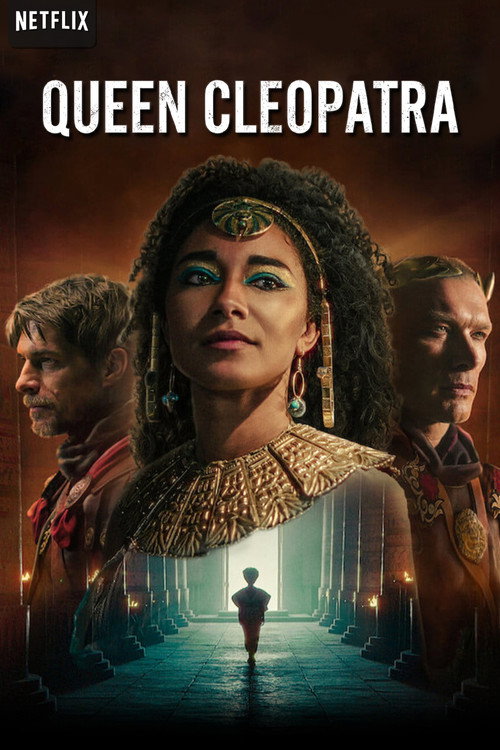
A docuseries that casts Cleopatra and her family as Black and argues for her as an African queen, while framing her story around Roman misogyny; it does not make her a saint, but the casting and the thesis run through every episode.
Queen Cleopatra is a four-part docuseries produced and narrated by Jada Pinkett Smith, mixing dramatised scenes with interviews of historians. It follows Cleopatra from her father's death and the war with her siblings, through her alliances with Julius Caesar and Mark Antony, to Actium and the fall of Ptolemaic Egypt.
The messaging has two strands. The first is ethnicity: Cleopatra, a Ptolemy of Macedonian Greek descent, is played by a Black actress, as are her sister Arsinoe and her attendants. The first episode opens on a historian recalling her grandmother's insistence that Cleopatra was Black, then argues that her ancestry is unknown and that insisting she was European is questionable, and experts keep calling her an African queen until the last episode closes on that claim as a truth that was buried and erased. The second strand is gender: the opening narration hails women who bowed to no man, and the series returns again and again to Roman misogyny, from a staged put-down of Cicero to experts calling Octavian's propaganda misogynistic and xenophobic.
What keeps the score from going higher is that the series does not make its heroine flawless. Experts call the Ptolemies violent, and Cleopatra presses for her rivals' deathspresses for Arsinoe's death, probably has her brother Ptolemy XIV killed and is faulted for putting her own power first at Actium. Her enemies are not simply white Romans: her Egyptian court and siblings are the first villains, Caesar and Antony are drawn warmly, Egyptians desert her at the end, and Octavian is given motives. The third episode, which keeps to the Antony story and Actium, carries the least messaging.
Seasons and episodes
Each reviewed episode is scored on its own. Its categories are scored 0 to 3: 0 absent or presence only, 1 brief, 2 recurring or plot-relevant, 3 central or dominant. Open an episode for its breakdown. Timestamps refer to the episode's running time.
Season 1
6.0Strong4 episodes reviewed6.0S01E01 RivalsSets out the series' thesis: a narration about women who bowed to no man, a historian's 'Cleopatra was Black' story and a case against seeing her as European, all around her fight with her siblings for the throne.
| Category | Score | What we saw |
|---|---|---|
| Content | ||
| A Ethnicity | 3 | The episode makes Cleopatra's ethnicity a message. It opens its history on an anecdote that she was Black, gives a segment to arguing that her ancestry is unknown, that ancient Egyptians ranged in skin colour as other African peoples do, and that insisting she was European is questionable, with no voice making the case for her documented Macedonian line, and then calls her an African woman. Her alliance and affair with Caesar, played by a white actor, is also a mixed couple created by the casting: 3 for the episode's central relationship, minus 1 because the story deals with the difference as Roman hostility to her (step 3), so 2, below the 3 the ethnicity message reaches.
|
| B Gender and feminism | 2 | The series is framed as a story of female power. The opening narration hails a time when women ruled and bowed to no man, and experts stress that the queen did not bow to Caesar, that unlike Roman women she was a national leader, and that her female advisers are overlooked by scholars. Scored 2, not 3: after the opening these are scattered remarks in an episode about a dynastic war, and the contrast with Roman women's place is history the setting accounts for.
|
| D Power and systems | 0 | Cleopatra's complaint in council that Egyptians starve to feed Rome and that Egypt must not become a mere colony (0:20:34, 0:20:38) is one line of dynastic politics, not a theme of colonial oppression. |
| E Cultural and historical revision | 3 | Cleopatra VII, a Ptolemy of Macedonian Greek descent, is played by a Black actress throughout, and her sister Arsinoe and her attendants Charmion and Iras are cast the same way. The lead is recast, so 3. The episode itself names the family's Macedonian origin (0:02:26, 0:05:00) and admits her ancestry is uncertain, which makes the casting a choice rather than a reading of the record.
|
| K Diverse cast | 0 | The cast divides into Egyptians and Romans, the two peoples the true story has. That the Ptolemies are played by Black actors is the recasting scored under E, not a further mix. |
| L Climate and environment | 0 | The Nile's failure to flood (0:17:47) is a natural disaster the plot turns on, with no climate message. |
| Treatment | ||
| G Antagonist coding | 0 | The villains are Egyptian court figures, the eunuch Pothinus and the boy king Ptolemy XIII, and Arsinoe, who is played by a Black actress. The one prominent white man, Caesar, is an ally drawn as a fair diplomat (0:36:48). |
| H Didacticism | 2 | Both messages are stated outright: the narration on women who ruled, and the experts' case on Cleopatra's ancestry and skin colour.
|
| I Message over story | 2 | The series builds its argument around the casting: the history begins only after the 'Cleopatra was Black' anecdote, and a detour on her ancestry presents only the African possibility while the dramatised scenes show her as Black throughout.
|
| J Left-leaning politics framed as good | 0 | Caesar is said to stand for the people and Pompey for the rich Optimates (0:19:02), a neutral account of the Roman civil war. |
C and F score 0.
Categories add up to 12 of 36, which gives 6.5. Counterweight −0.5: The heroine is not drawn as flawless: experts call the Ptolemies violent and not good people (0:05:14) and compare the family to Game of Thrones (0:08:18), and Cleopatra makes Caesar promise to have Arsinoe killed as a traitor (0:45:55). The antagonists are her own court and siblings, and Caesar is shown fairly, restoring her and cutting Egypt's debt (0:37:43). Episode rating 6.0, strong.
6.0S01E02 When in RomeCleopatra's stay in Rome is framed around Roman misogyny and dislike of a foreign queen, with a staged put-down of Cicero; her own ruthlessness toward her siblings is shown too.
| Category | Score | What we saw |
|---|---|---|
| Content | ||
| A Ethnicity | 2 | The cold open calls her an African queen, and an expert says Rome's rich men despised her for being different and a foreigner. The mixed couple created by the casting, Cleopatra and Caesar with their son in Rome, is the episode's central relationship: 3, minus 1 because the story deals with the difference as Roman hostility to the foreign queen (step 3), so 2.
|
| B Gender and feminism | 3 | Roman misogyny is the episode's frame for Cleopatra's time in Rome. Experts set out a male-centred Roman system against Egyptian women's near-equal rights, a staged banquet scene has her put down Cicero for a leering remark to a cheering toast, and an expert sums up that Rome opposed a woman ruler, as simple as that.
|
| C Sexuality and gender identity | 0 | An expert's aside on the fluid sexuality of ancient Egypt, to say Caesar was probably not her first lover (0:13:19), is a passing remark, not a message about sexuality. |
| D Power and systems | 0 | Rome's male-centred system is scored under B. The rest is Roman politics, Caesar's dictatorship and the plot against him, told without an identity angle. |
| E Cultural and historical revision | 3 | Cleopatra, the lead, is played by a Black actress throughout, as in every episode; her attendants Charmion and Iras, also cast as Black, travel with her to Rome.
|
| K Diverse cast | 0 | Egyptians and Romans, the peoples of the true story; the casting of the Egyptians is scored under E. |
| Treatment | ||
| G Antagonist coding | 1 | Cicero and Rome's elite men are cast as the sneering, sexist side against Cleopatra, and the senators who murder Caesar are called barbarians. Scored 1: Caesar is drawn warmly, and the Roman crowd takes pity on the captive Arsinoe (0:04:37).
|
| H Didacticism | 2 | Experts lecture on Roman attitudes to women and to a woman ruler.
|
| I Message over story | 1 | The banquet scene with Cicero is staged to dramatise the misogyny thesis, ending in a toast to her victory. The rest of the episode follows the history.
|
| J Left-leaning politics framed as good | 0 | Roman republicanism and Caesar's dictatorship are explained neutrally (0:18:21, 0:23:18). |
F and L score 0.
Categories add up to 12 of 36, which gives 6.5. Counterweight −0.5: Cleopatra is shown as ruthless: she demands to know why Arsinoe is still alive (0:11:27), an expert thinks she probably had her brother Ptolemy XIV killed and calls it the family's usual solution (0:37:17, 0:37:44), and she suggests Arsinoe's death to Antony in bed (0:43:45) and an expert calls her a survivor who would do anything to stay alive (0:44:18). Caesar is given his own reasons, keeping his promise to the Roman people above his promise to her (0:11:56). Episode rating 6.0, strong.
4.5S01E03 What Must Be DoneMostly the Antony romance and the road to Actium; the messaging is the casting, Roman propaganda against a foreign queen and generals who will not follow a woman.
| Category | Score | What we saw |
|---|---|---|
| Content | ||
| A Ethnicity | 2 | No ethnicity message is argued in this episode. The mixed couple created by the casting, Cleopatra and Antony, played by a white actor, is the central romance: 3, minus 1 because the story deals with the difference, as Rome objects to the marriage and Antony's allies distrust an eastern queen (step 3), so 2.
|
| B Gender and feminism | 2 | Gender recurs: Octavian's propaganda brands her the seductress though Antony was the unfaithful one, an expert stresses that she took part in military life rather than staying in the palace, and a staged scene has Antony's generals refuse to follow a woman until she faces them down.
|
| E Cultural and historical revision | 3 | Cleopatra, the lead, is played by a Black actress throughout.
|
| K Diverse cast | 0 | Egyptians and Romans, the peoples of the true story; the casting of the Egyptians is scored under E. |
| Treatment | ||
| G Antagonist coding | 1 | Octavian and his propaganda, and the generals who will not obey a woman, are white Roman men set against Cleopatra. Scored 1: Octavian is the true story's enemy, and Antony, also a white Roman, is her husband and ally.
|
| H Didacticism | 1 | One expert passage states the point, on propaganda that blamed the woman for the man's betrayal.
|
| I Message over story | 0 | The story leads: the Antony romance, the Parthian campaign and Actium. The casting is scored under E. |
C, D, F, L and J score 0.
Categories add up to 9 of 36, which gives 5.0. Counterweight −0.5: The episode faults its heroine: experts list many bad decisions by her and Antony at Actium (0:32:51), say her retreat looked like betrayal from Rome's side (0:34:22), and that she was really thinking of her own power and put herself and her family first (0:36:02). It credits her rule with Egypt's prosperity (0:09:14), but does not spare her. Episode rating 4.5, moderate.
6.5S01E04 The Last PharaohThe fall of Egypt, told with Octavian as a sneering villain whose propaganda is called misogynistic and xenophobic, and closing on the claim that Cleopatra was an African queen whose truth was erased.
| Category | Score | What we saw |
|---|---|---|
| Content | ||
| A Ethnicity | 3 | Ethnicity is the episode's closing message: an expert calls Octavian's propaganda xenophobic, Octavian sneers at her African magic, her daughter becomes a queen of Africa too, and the series ends on a historian saying she wants the story told because Cleopatra was an African queen, a truth that was buried, erased and hidden. The mixed couple with Antony scores 2 as in the third episode (3 for the central romance, minus 1 because the story deals with Roman hostility).
|
| B Gender and feminism | 2 | The misogyny theme recurs: the propaganda against her, her choosing her own death rather than letting Octavian or the senate decide, and a closing tribute to a free and powerful woman whose story every woman will understand.
|
| D Power and systems | 1 | Rome's conquest is framed as the plundering of a nation: Egypt would become Rome's farm whatever it suffered, lost its independence, and had its treasury emptied to pay Rome's armies. Scored 1: this is the historical outcome, told in the epilogue.
|
| E Cultural and historical revision | 3 | Cleopatra, the lead, is played by a Black actress throughout.
|
| K Diverse cast | 0 | Egyptians and Romans, the peoples of the true story; the casting of the Egyptians is scored under E. |
| Treatment | ||
| G Antagonist coding | 1 | Octavian, the true story's victor, is drawn as a cruel villain who sneers at her race and sex and threatens her children. Scored 1: he is one character, given motives, while Antony is on her side and her own Egyptian forces desert her.
|
| H Didacticism | 2 | The experts state both messages, on misogynistic and xenophobic propaganda and on the erased African queen.
|
| I Message over story | 1 | The body of the episode follows the history of the fall, but the series ends by turning it into the thesis: a historian's dream of an ancient woman who told her to tell her story, then the African-queen claim.
|
C, F, L and J score 0.
Categories add up to 13 of 36, which gives 7.0. Counterweight −0.5: An expert thinks Cleopatra weighed killing Antony once he was of no more use to her (0:05:14), and another says she was a pragmatist, not a romantic (0:07:06). Egyptians defect to Octavian (0:12:22, 0:20:11), and Octavian is given motives: he needed Egypt's wealth to pay his soldiers (0:09:15) and feared that a martyred queen would spark a revolt (0:24:51). Episode rating 6.5, strong.
How the number is reached
- Each reviewed episode is scored A to L and rated like a film: its total ÷ 18 × 10 (at most 10) gives a rating, rounded to the nearest 0.5, less the episode's counterweight. Open an episode above to see how.
- Season 1: the average of 6.0, 6.0, 4.5 and 6.5 gives 6.0.
- With one season reviewed, the show's rating is that season's: 6.0, strong.
Considered, scored 0
- Native Egyptians in the street, temple and court scenes, played by Black actors (S01E01 0:13:30, 0:16:30); the show's own experts say ancient Egyptians varied in skin colour, so only the recast Ptolemies are scored (E).
- The Egyptian–Roman mix of the cast, which is the true story's two peoples (K); the skin colour given to the Ptolemies is scored under E.
- Arsinoe, played by a Black actress, is Cleopatra's scheming rival (S01E01 0:43:23, S01E02 0:34:00), not a flawless portrayal (A).
- An expert's aside on the fluid sexuality of ancient Egypt (S01E02 0:13:19), a passing remark about Cleopatra's earlier lovers (C).
- The Nile's failure to flood (S01E01 0:17:47), a natural disaster with no climate message (L).
- Cleopatra Selene's marriage to Juba of Mauretania (S01E04 0:38:24), mentioned in the epilogue but not shown.
Evidence and confidence
Confidence: Medium. All 4 of the owner's 4 episodes were reviewed, the whole series. The only subtitle track available was a Filipino translation of the English dialogue, read in full and translated back; evidence notes paraphrase that translation, so exact English wording may differ slightly.
Category F definition: As in the rubric: Islam shown as a peaceful and tolerant religion, aligned with human rights, in a way that works as a corrective message.
Rubric version 5. Reviewed 21 November 2026.